Photo by: Philip Wyers / Snappr News
Everything announced at GDC 2026
Developers from around the world gathered in San Francisco for GDC 2026, the gaming industry’s largest conference, featuring keynotes, demos, and discussions on AI, game design, and the future of interactive entertainment.
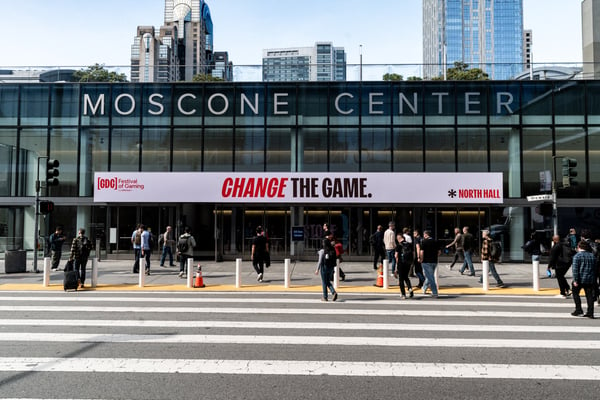
The Game Developers Conference came back to San Francisco's Moscone Center for its 2026 edition under a new name: GDC Festival of Gaming. The rebranding, announced in late 2025, reflected what organizers called a need for "more connection, visibility, and support" across an industry still recovering from two years of mass layoffs and studio closures.
Attendance reached 20,000 across the week of March 9-13, a notable drop from the 30,000 the event drew in its peak years. The North Hall expo area was closed entirely, a space previously reserved for developers to showcase games and hold meetings. But the reduced footprint worked in the event's favor. Conversations on the South Hall floor and in the session rooms carried more weight, with attendees reporting a focus on practical problem-solving over spectacle.
The simplified pass structure was one of the most talked-about changes. Where previous years offered nearly a dozen pass types at varying access levels, 2026 introduced just two: a Festivals Pass starting at $649 (45% cheaper than last year's All-Access pass) and a premium Game Changer Pass. Every attendee could access every session, ending the longstanding frustration of being turned away from talks for having the "wrong pass."
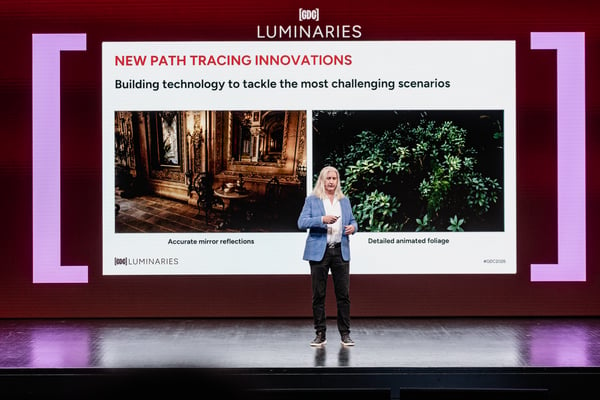
NVIDIA dominated the announcements. The company revealed that 20 games would natively support DLSS 4.5, including 007 First Light, CONTROL Resonant, and Star Wars: Galactic Racer, with Dynamic Multi Frame Generation launching March 31 via a beta update. The biggest technical reveal was RTX Mega Geometry, a new foliage system built in collaboration with CD Projekt RED for The Witcher 4. The technology allows path tracing in dense forest environments with millions of individually animated plants, something that had been computationally impossible until now.
Insights
Beyond the booths
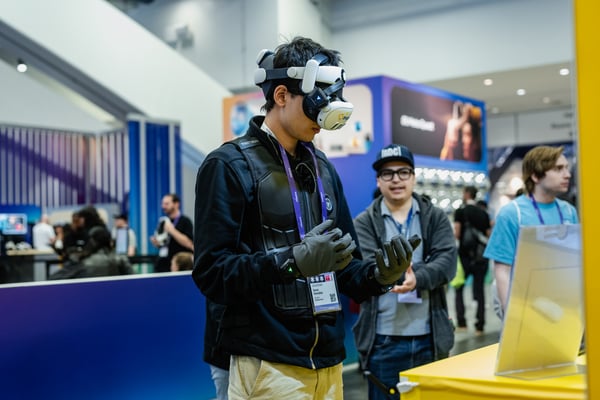
Beyond the headline announcements, GDC 2026 was shaped by the industry's reckoning with AI and its impact on development teams. Session after session returned to the same question: how do studios integrate AI tools without losing the craft that makes games feel human?
Roblox showed up with a strong presence at Booth 1235, demonstrating 4D generative tools that let players create their own vehicles inside games. The company also presented a session on how small teams of fewer than 10 developers are capturing audiences of 25 million concurrent users by prioritizing social loops over static content. It was a clear signal about where the platform sees the future: smaller teams, faster iteration, AI-assisted creation.
The GDC Awards ceremony capped the week, celebrating standout titles including Clair Obscur: Expedition 33 and Baby Steps alongside industry veterans. Postmortems of games like Death Stranding 2: On the Beach and Ghost of Yotei drew packed rooms, with developers sharing the unglamorous realities of shipping ambitious titles in a contracting market.
The geopolitical backdrop was hard to ignore. Attendance from international developers, particularly non-American studios, was visibly lower than previous years, attributed to both the start of the 2026 Iran conflict and increasingly aggressive U.S. immigration policies under the second Trump administration. Several European and Asian developers told press they had opted to participate virtually or skip entirely.
Despite the smaller crowd and the closed North Hall, GDC 2026 felt like a deliberate reset rather than a decline. The conversations were more honest, the pass structure more inclusive, and the industry more open about the challenges ahead. As organizer Nina Brown put it in her opening remarks, the goal was to "celebrate the interconnection between creators, leaders, and partners that drive the industry forward."
Related stories
View all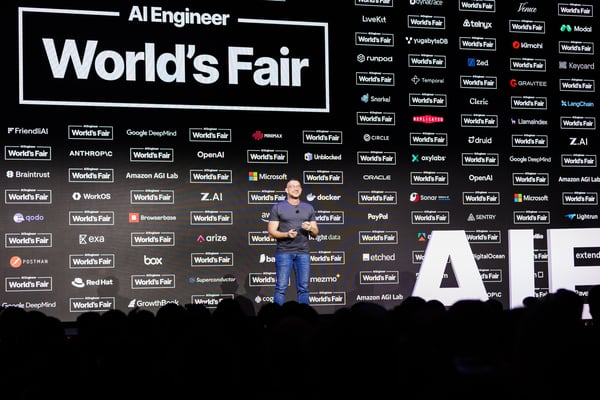
AI engineers told 'the model alone is no longer the product' as World's Fair opens in San Francisco
The AI Engineer World's Fair opened Tuesday at Moscone West in San Francisco, drawing more than 6,000 attendees and keynotes from Microsoft, OpenAI and Hugging Face, with a surprise appearance from OpenClaw creator Peter Steinberger.
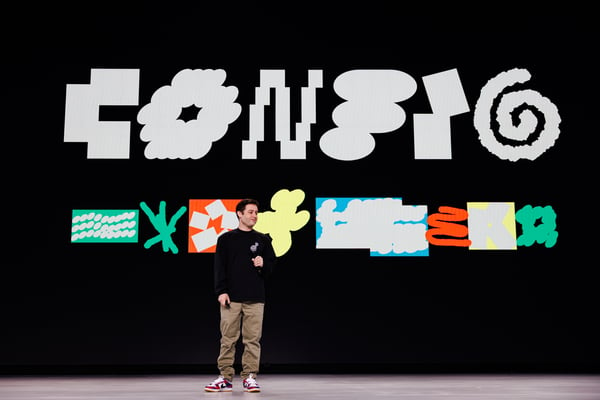
'Code is material for design': Figma announces new code layers at Config 2026
Figma unveiled new coding, animation and AI features at its Config 2026 conference in San Francisco, including code layers, native motion support, generative plugins and AI agent upgrades.

Food & Beverage Leaders Gather at SF's Taste of Asia Summit
The eighth annual Taste of Asia North American Food & Beverage Industry Summit drew restaurant operators, brand founders, investors and industry partners to Shenzhen Bay Innovation Center in San Francisco on June 15 for an evening of networking and deal-making. The event, part of a 2026 multi-city tour organized by NAAFIA and Asia Creative, featured a VIP mixer and programming on market trends, brand growth and cross-border business opportunities in the Asian food industry.