
Every guide to visual content skips the part where it gets made
There is no shortage of writing about visual content marketing. Nearly all of it stops at the same place: pick the right format, stay on brand, optimize for the platform, measure engagement. Useful advice, and completely silent on the question a marketing lead actually has to answer when the budget conversation starts. What does it take to produce this stuff, consistently, across a hundred locations, every month?
That question has been hard to answer because the people who publish visual content research mostly sell software or stock libraries. They can tell you what consumers say they want. They cannot tell you what it costs in labor, hours and rejected frames to put a real photograph of a real thing in front of a customer.
Snappr sees that side of the work every day. Its network completed more than 70,000 commercial shoots over the last year, across food, automotive, real estate, product, events and portraits, and its in-house editors worked on the majority of those galleries. This guide draws on the patterns that show up at that volume: what gets captured and thrown away, how long delivery really takes, what goes wrong, and when demand spikes.
Some of it is uncomfortable. In real estate, roughly three of every four frames a photographer captures never reach the client. Full-day catalog shoots routinely run past a standard 48-hour delivery window. And about one edited gallery in three needs something fixed before it ships. None of that appears in a vendor brochure, which is exactly why it belongs in a guide to what visual content marketing actually involves.
The figures that follow are rounded and directional. They describe the shape of the work, not any single customer's program.
What businesses actually book
Start with the mix, because it isn't what a general marketing audience expects. Enterprise food and automotive shoots together make up nearly half of everything Snappr's network books.
Food is the largest category by a wide margin, with well over 20,000 enterprise bookings in the last year alone, most of them around 90 minutes long. Enterprise automotive comes next, typically at two hours a shoot. Then the shape changes, and consumer family sessions and business events fill out the top of the list.
Two things fall out of that distribution. The first is that high-volume commercial visual content is concentrated in a small number of repeatable, operationally standardized shoot types. A 90-minute food shoot in a restaurant kitchen is a very different production problem from a wedding, and it is the food shoot that scales. The second is that the long tail is genuinely long: dozens of distinct shoot types, covering everything from maternity to fashion to religious ceremonies.
Enterprise product shoots are the outlier worth flagging. They're a fraction of the volume, but a typical session runs a full working day. Catalog photography is a fundamentally different unit of work from everything else on the list, and any plan that budgets it at the same rate as a headshot session is wrong before it starts. If you are scoping catalog work, Snappr's guide to catalog management covers the operational side in more detail.
The keeper ratio, and why culling is the hidden cost
Here's the part of the job nobody outside the industry talks about.
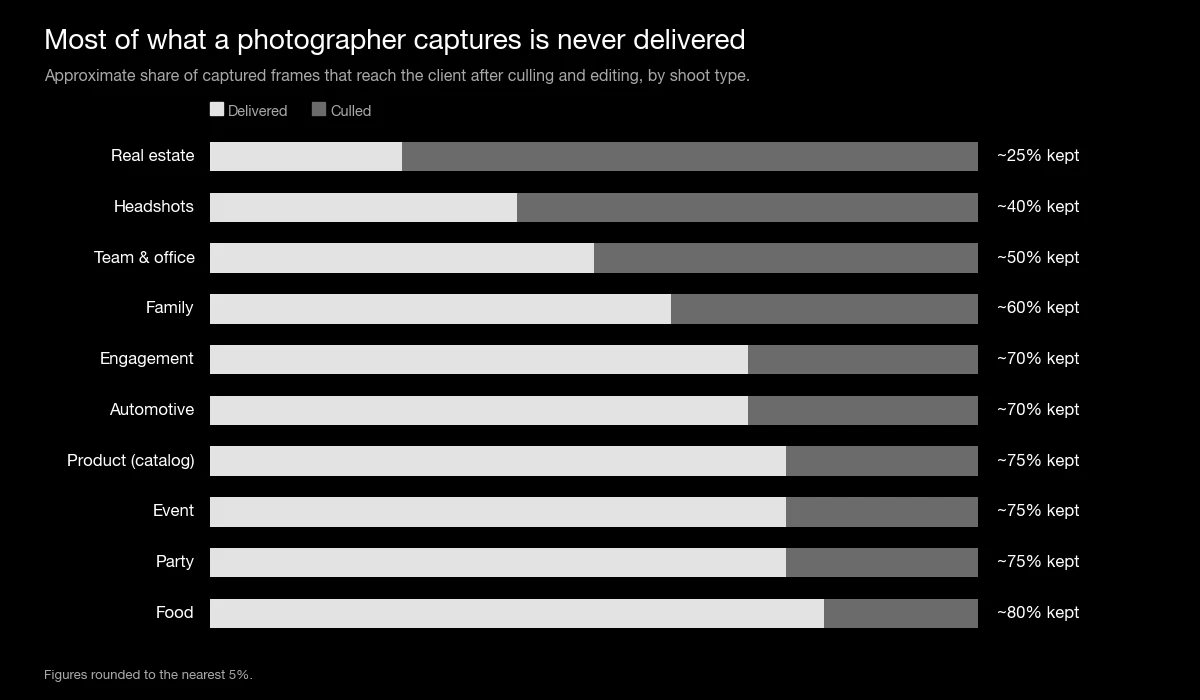
Compare how many frames a photographer captures with how many reach the client, and the gap is large. It also varies widely by vertical.
Real estate is the extreme. A typical real estate shoot captures well over a hundred raw frames and delivers a few dozen, a keeper rate of roughly one in four. Around three quarters of everything taken is culled before the client ever sees it.
Headshot and profile sessions keep around 40% of what's shot, and team and office shoots about half. Family sessions sit closer to 60%.
At the other end, automotive and catalog product shoots keep roughly 70 to 75% of frames, and food is the tightest of all at close to 80%. That food figure carries a caveat worth stating: food shoots are a highly controlled, per-item capture process with very few raw frames per dish, so the ratio reflects deliberate restraint at the point of capture rather than light editing afterwards.
Why does this matter to someone building a visual content marketing business case? Because the keeper ratio is the clearest available evidence that culling and editing are real labor, not a line item padding an invoice. When a real estate photographer bills for a shoot, roughly three quarters of the frames they captured were work performed and then discarded on purpose. That is not waste. That is the selection process that makes the delivered set good.
Redfin's own photography team describes the technique directly, explaining that a single finished listing image is built by capturing multiple exposures and stacking them, so that shadows and window brightness resolve properly. One delivered photograph can represent several captured frames before culling even begins. A one-in-four keeper rate is what that craft looks like across thousands of jobs.
It also reframes a common procurement mistake. Teams comparing a professional quote against an in-house option almost always compare shoot time against shoot time, because that is the visible part. The invisible part is the discarded frames, and whoever takes the work in house inherits that labor whether they budgeted for it or not.
Turnaround: what a 48-hour promise means in practice
Speed is the second thing enterprises ask about, and the second thing few vendors discuss honestly. Snappr's standard delivery target for most shoot types is 48 hours after the shoot.
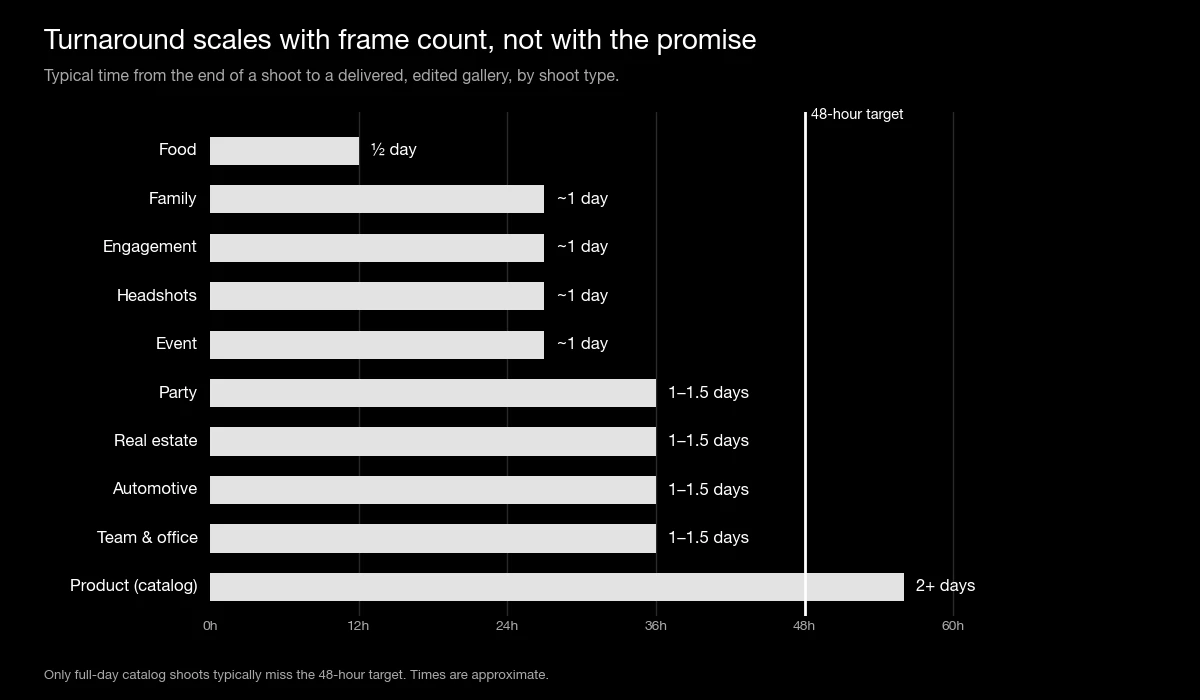
Food is the benchmark. A typical food gallery is delivered in around half a day, and the vast majority land well inside 48 hours. That's what a standardized, high-repetition visual content pipeline looks like when it's working.
Everything else takes longer. Headshots and events typically land a little over a day after the shoot. Real estate and automotive usually take around a day and a half, still inside the target at the median but with less headroom.
Full-day catalog shoots are the exception, and it would be dishonest to bury that. They typically run past the 48-hour window. The reason is visible in the shape of the job: a full day of capture produces hundreds of raw frames, and more frames mean more editing hours. A standard 48-hour target was never built for that kind of work.
The planning lesson generalizes beyond Snappr. Turnaround scales with frame count and shoot duration, not with the vendor's marketing promise. Any team writing a content calendar that assumes uniform delivery across shoot types is building in a slip it hasn't accounted for.
What actually fails, and where it gets caught
This is the section most vendors would leave out. Roughly seven in ten edited galleries clear quality control with nothing to fix. The other three come back with something.
The failures are not what people assume. Color correction and exposure are the two biggest categories by far, and together they make up around two thirds of everything flagged. Cropping and straightening is a distant third. Culling itself, a reviewer disagreeing with which frames were selected, is rare.
The genuinely serious categories are rarer still. Image quality failures, missed client instructions and incorrect sequencing each show up in well under 1% of shoots.
There is a second checkpoint earlier in the pipeline, at raw upload, before editing begins. Most shoots arrive clean. The most common problem is an incomplete set of photos, followed by photo quality issues and file naming mistakes. Corrupted files are rare.
File hygiene deserves more attention than it gets, because it is the point where production quality turns into discoverability. Naming and technical specification problems sound trivial until you consider that filenames, dimensions and format are exactly what image search and on-site merchandising systems read. A gallery that is beautiful and misnamed is a gallery that is harder to find, harder to route to the right product page, and harder to audit later. Most advice about optimizing images for search starts at alt text on a published page. It should start three steps earlier, at the naming convention the photographer is given before the shoot.
Read those two checkpoints together and a fairly specific picture emerges of what a visual content operation actually has to be good at. It is not artistic judgment, which almost never fails. It is color management, exposure consistency and file hygiene, performed identically across thousands of jobs by hundreds of different people. Those are process problems, and process problems are exactly what in-house teams are worst equipped to solve at volume, because the failure rate only becomes visible once you are running enough jobs to see the pattern.
It is also why the AI editing conversation is more interesting than it first appears. Color and exposure, the two dominant failure modes, are precisely the corrections that machine editing handles well. Snappr's breakdown of what AI photo editing can and cannot do goes further into where the line currently sits.
Demand is seasonal, and planning for the average will fail
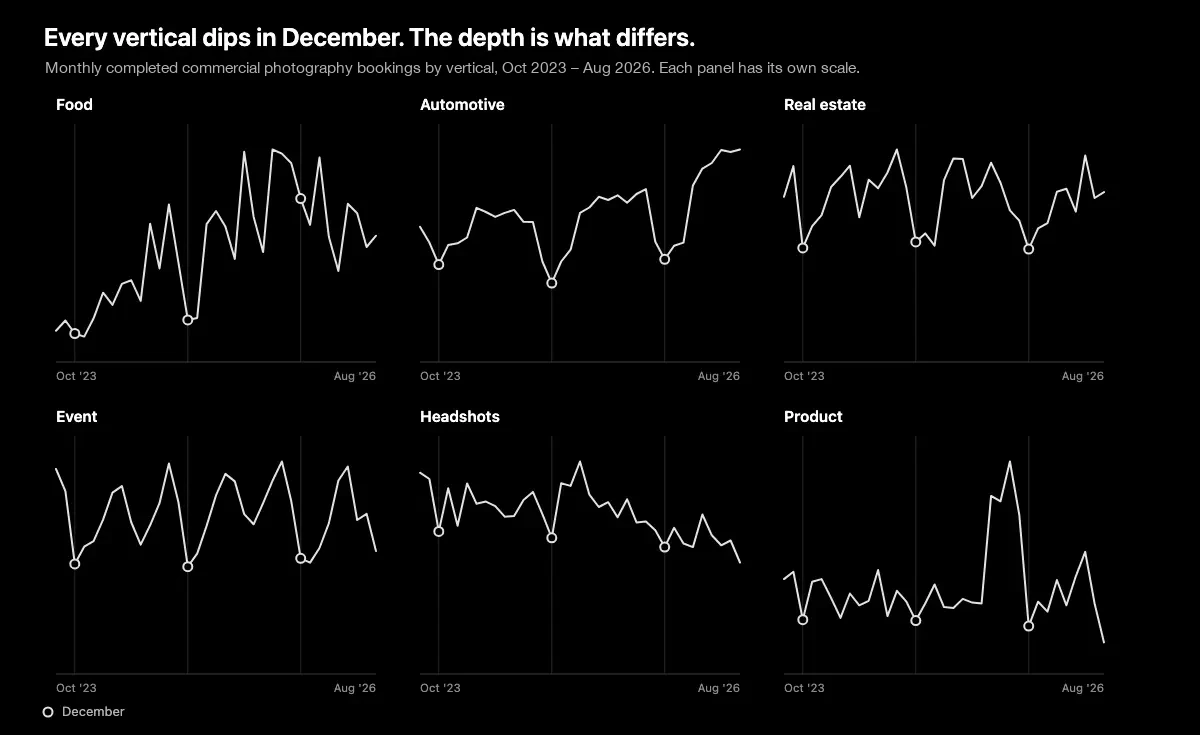
December is the one dip every vertical shares. In automotive, December volume has fallen to less than half of the summer peak. Real estate drops by around 40% from its spring and summer highs. Event photography peaks hard in October and roughly halves by December and January.
The seasonal shapes differ by vertical, which matters if you operate across more than one. Event work peaks in October. Real estate peaks across late spring and early summer. Food is the least seasonal and the most volatile, with its busiest months running at more than double its slowest, driven by enterprise campaign timing rather than any natural calendar. Automotive has climbed steadily through 2026.
For anyone resourcing a visual content program, the practical consequence is that capacity planned against a twelve-month average will be badly wrong twice a year. The October event peak and the December trough are roughly a two-fold swing in the same vertical within ninety days. Fixed in-house headcount either sits idle in December or fails in October. It cannot do both.
How to tell if volume is actually saving you money
The question every enterprise buyer asks is whether unit cost falls with volume. The honest answer is that it usually does, but a per-shoot comparison will hide it.
The reason is mix. High-volume buyers tend to book longer and more complex shoots than one-off buyers. A catalog team booking hundreds of sessions a year books full-day shoots, where a one-off product customer books a couple of hours. An automotive marketplace books two-hour inventory shoots where a private seller books one. Compare price per shoot and the two effects cancel out: a genuine volume discount, hidden behind a shift to bigger jobs.
Compare price per shoot minute within the same shoot type instead, and the discount appears. It's largest in long, repeatable categories such as catalog, automotive and real estate, where standardized shot lists and predictable locations make each additional shoot cheaper to run.
Not every category rewards volume. Headshot sessions are short and fixed-length whether you book one or a thousand, so there is little mix effect to unwind and little economy of scale to find.
The broader point is that the operational design that serves a customer booking hundreds of shoots a year has very little in common with the one that serves a customer booking one. Pricing follows the operation, not the other way round.
What this means by vertical
The patterns land differently depending on what you sell.
For restaurants and delivery platforms, food is both the highest-volume and the fastest-delivering category, typically back in around half a day. The production problem is solved; the remaining problem is coverage. Snappr's work on the ROI of professional food photography and its broader food photography guide cover how menu coverage translates into order volume.
For real estate and property management, the one-in-four keeper rate and a turnaround of roughly a day and a half are the two things to plan around. Listing velocity depends on both. Renters Warehouse increased inquiries tenfold and personal tours threefold after standardizing its photography, and Snappr's analysis of how professional photography helps homes sell 32% faster sets out the listing-side mechanics. For teams layering in tours and floor plans, there is also a rundown of technologies that complement real estate photography.
For automotive marketplaces, a high keeper rate and steadily climbing volume reflect an industry that has already accepted photography as inventory infrastructure. Bring a Trailer is the clearest proof: Snappr's account of a 20-year-old Honda Civic selling for $50,000 entirely online, and Carvana's route to becoming the number one all-online used car marketplace by photographing flaws rather than hiding them, both rest on gallery completeness. The psychology behind why used car buyers prefer buying online explains the buyer behavior underneath.
For e-commerce, full-day catalog shoots and turnaround that can run past 48 hours are the planning constraints. Baymard Institute's usability research found that 25% of e-commerce sites do not provide product images with sufficient resolution or zoom, which is a production failure showing up as a conversion failure. Snappr's piece on why high-quality product photography can boost conversions by 90% covers the revenue side.
For travel and hospitality, Expedia Group tells partners plainly that bad photos are the number one reason travelers rule out a property. Photography is not a marketing asset in that context. It is a filter that removes you from consideration before a human reads a word, and it operates faster than reading. MIT neuroscientists found the brain can identify an image seen for as little as 13 milliseconds.
Where AI genuinely helps, and where it does not
The quality control patterns point at the answer. Color correction and exposure make up about two thirds of quality control fixes, and both are deterministic, rule-following corrections. That is the part of the pipeline where machine editing earns its place. Culling disagreements, by contrast, are rare, and judgment about which frame is the good one remains stubbornly human.
The wider market is moving the same way. Wyzowl's 2026 survey found that 63% of video marketers have used AI tools to create or edit marketing videos, up from 51% a year earlier. Adoption is rising fast on the editing and generation side.
Trust is the constraint. Getty Images' VisualGPS research, drawing on a sample of 7,500 adults per survey across 25 countries, found that 98% of consumers agree authentic images and video are pivotal in establishing trust. Nielsen Norman Group's usability work makes the same point from a different angle, distinguishing information-carrying images from decorative ones and finding that users engage with images that carry real content about the thing they are evaluating, while ignoring images that merely fill space.
That is the practical dividing line. A generated image is a decorative image unless it depicts the actual product, property or dish the customer is buying. For catalog variation, background swaps and editing throughput, generation is genuinely useful. For the hero frame of a real thing a customer is about to pay for, capture still wins.
Snappr runs both. Capture covers human photographers and videographers; Magic is a family of per-vertical AI generation and editing products, with versions for food, automotive, real estate and editing. Magic Studio, a chat and canvas interface for generating and editing images from past shoots or new prompts, launched on 4 September 2026 with a free generation allowance across all three tiers.
Why in-house visual content operations break
Nothing in this guide argues that an in-house team cannot take good photographs. They can. The failure mode is different, and the patterns above name it precisely.
An in-house operation has to solve four problems at once. It has to absorb a roughly two-fold seasonal swing in demand without carrying idle headcount through December. It has to hold color and exposure consistent across every operator, when those two failures alone account for around two thirds of quality control fixes. It has to keep delivery inside 48 hours when frame volumes vary more than tenfold between a food shoot and a catalog shoot. And it has to absorb the culling labor behind a one-in-four keeper rate, which never appears on any brief.
The labor market makes this harder. The US Bureau of Labor Statistics counts 145,000 photographers with employment projected to decline 1% between 2025 and 2035, while about 10,700 openings a year come entirely from replacing people who leave the occupation. That is a flat-to-shrinking, high-churn talent pool. Building a distributed in-house capture team means recruiting continuously against that.
Wyzowl's survey shows the same tension on the video side, where 59% of businesses create video in house but 42% still rely on external creators in some capacity, and the most commonly cited reason for not using video at all, at 24%, is cost.
Scale is what changes the equation. Snappr's enterprise page notes that the platform serves over 70% of Fortune 500 companies, and the Bring a Trailer engagement alone covers more than 30,000 photoshoots and 4 million assets, with a measured 2.5% lift in average sale price. Those outcomes come from operational consistency, not from any individual photograph.
Building the business case
If you are writing the internal case, this guide gives you five inputs that most proposals miss.
Budget the culling, not the shoot. Take the keeper rate for your vertical and understand that the delivered set is the visible fraction of the work. In real estate, a few dozen delivered images can take well over a hundred captures.
Plan turnaround by frame count. A 90-minute food shoot can come back in about half a day. A full-day catalog shoot can take more than two. Plan for the one you are actually booking.
Assume roughly one gallery in three needs a fix, and ask who absorbs it. On a platform, rework happens before delivery. In house, it happens after publication, or not at all.
Size capacity to the peak, not the mean. The swing from the autumn peak to the December trough is roughly two-fold in event and real estate work.
Model unit cost per shoot minute, not per shoot. That's the only view in which a volume discount is visible, and it varies a lot by category, with short fixed-length sessions like headshots showing little or none.
What changes next
Four things are worth watching into 2027.
Generation moves into the long tail first. The categories with the lowest keeper rates and the most repetitive framing requirements, such as headshots and team and office shoots, which already discard more than half of what's shot, are where synthetic variation has the least to lose.
Disclosure becomes a production requirement rather than a legal one. With 98% of consumers linking authenticity to trust, provenance labeling is heading toward being a default field in the asset pipeline.
Turnaround expectations compress toward the food benchmark. Half-day delivery in the highest-volume category sets the reference point that every other vertical gets measured against.
Enterprise programs pull further ahead. The operational gap between suppliers built for hundreds of shoots a month and everyone else widens rather than narrows.
Talk to us about your visual content program
If you are resourcing visual content across multiple locations, verticals or markets, the patterns in this guide are the ones worth arguing about internally before you commit headcount. Book time with Snappr's Enterprise team for an assessment of what your volume, mix and turnaround requirements actually imply.
Frequently asked questions
What is visual content marketing?
Visual content marketing is the use of photography, video, graphics and other imagery to drive commercial outcomes such as conversion, bookings and sales. In practice at enterprise scale it is an operations discipline as much as a creative one, covering capture, editing, quality control and delivery across many locations.
What is a keeper rate in photography?
The keeper rate is the share of frames captured during a shoot that are actually delivered to the client. Across Snappr's centrally edited shoots it ranges from roughly one in four in real estate to close to 80% in food photography, so in many verticals most captured frames are deliberately culled during editing.
How long should professional photo delivery take?
Snappr's standard target is 48 hours after the shoot for most types. In practice a food shoot is often delivered in around half a day, while full-day catalog shoots can take longer than two days, because turnaround scales with frame volume and shoot duration.
Does visual content get cheaper at higher volume?
Usually, but only when you measure price per shoot minute within the same shoot type. High-volume buyers tend to book longer, more complex shoots, which hides the discount in a per-shoot comparison. Short, fixed-length sessions such as headshots leave little room for volume savings.
What usually goes wrong with commercial photography?
Roughly seven in ten professionally edited galleries pass quality control with nothing to fix. Of the rest, color correction and exposure account for about two thirds of the issues, while serious problems such as image quality failures or missed client instructions each affect well under 1% of shoots.
Can AI replace photographers for visual content marketing?
Not for images of real products, properties or food that customers are about to buy, where Getty Images research shows 98% of consumers link authenticity to trust. AI is genuinely effective at the corrections that dominate quality control fixes, such as color and exposure, and at generating catalog variations from existing assets.
How seasonal is demand for commercial photography?
Highly, and differently by vertical. December is the one dip every vertical shares in Snappr's three years of booking data. Event photography peaks in October and roughly halves by December, and automotive volume in December has fallen to less than half of its summer peak.
Sources
1. U.S. Bureau of Labor Statistics, Occupational Outlook Handbook: Photographers — US photographer employment, median pay and ten-year outlook
2. Wyzowl, Video Marketing Statistics 2026 — AI video tool adoption, in-house versus external production, cost barriers
3. Getty Images newsroom, VisualGPS: Building Trust in the Age of AI — consumer attitudes to authenticity and AI imagery
4. Nielsen Norman Group, Photos as Web Content — information-carrying versus decorative imagery
5. Baymard Institute, image resolution and zoom research — share of e-commerce sites with insufficient product image quality
6. Expedia Group, property listing guidance for partners — photos as the top reason travelers rule out a property
7. Redfin, professional real estate photography — multi-exposure capture technique behind a single delivered listing image
8. MIT News, In the blink of an eye — speed of human image recognition


