

What 600 Diners Said They Look At First
Snappr commissioned a Google online consumer survey of 600 US adults and asked what they pay attention to when they choose where to order food. The answer was not the menu copy, and it was not the ratings.

Viewing food pictures scored 1.44 against menu descriptions at 1.00. Reading user reviews came in at 1.04, barely ahead of the text and well behind the photographs. Set those two against each other and pictures were rated 1.38 times as important as reviews.
The survey ran in 2020. We still cite it because it is our own data, the sample is real, and nothing since has reversed the direction. The more recent platform numbers further down point the same way.
Why Photos Beat Reviews
A review tells a diner what somebody else thought. A photograph tells them what turns up. On a delivery app the choice happens inside a scrolling list where every rival is one thumbnail away, and the photograph is the only element that answers the question actually being asked, which is whether this is the thing I want to eat right now.
That ordering matters operationally, because the two are not equally easy to move. A restaurant accumulates ratings over months and cannot rush them. It can photograph its menu in an afternoon.
What That Preference Does To Order Rates
Stated preference is interesting. Order rate is the number that pays. Deliveroo measured how much of each restaurant's menu carried a photograph, then measured how many visitors went on to order.
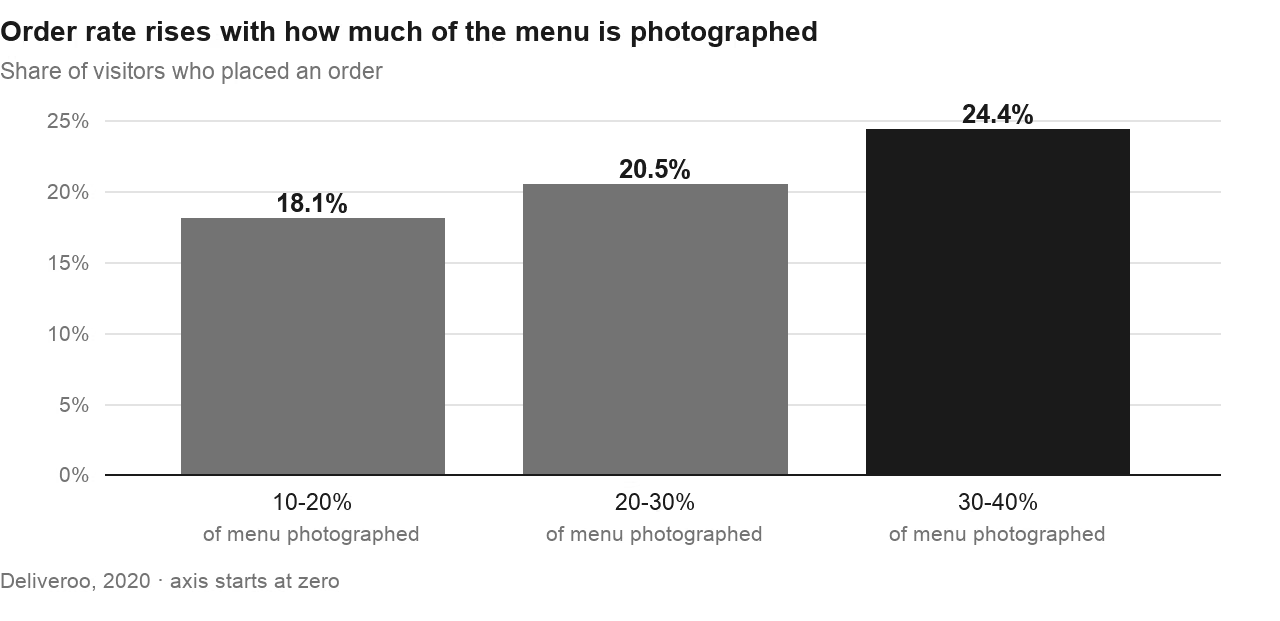
Restaurants with 10 to 20% of the menu photographed converted 18.1% of visitors. At 30 to 40% coverage that rose to 24.4%. The difference is 6.3 percentage points, which is a 35% increase in the rate at which a visitor becomes an order.
Note what is being counted. Not how beautiful any single photograph is, but how much of the menu has one at all. A restaurant with five immaculate photos and forty unphotographed items is in the bottom band.
The Same Pattern Holds In 2026
DoorDash's 2026 trends report, drawn from a Dynata survey of 3,001 US consumers and more than 500 restaurant operators, found that restaurants reaching 50% menu photo coverage saw an average 13% sales lift. Grubhub has reported a 30% increase tied to menu photography.
Different platforms, different years, different methods, and the same conclusion: coverage moves orders. For what else moves them, including the current photo specs on each platform and the seven other levers, read what wins orders on DoorDash and Uber Eats.
Photographing A Full Menu
Coverage turns this into a logistics problem rather than a creative one. Forty dishes shot consistently, re-shot when the menu changes, sized to each platform's rules, is not an afternoon with a phone once you are running more than one location.
Both platforms publish what they will accept. DoorDash lists its rejection reasons, including a 1400 by 800 pixel minimum and landscape 16:9 only, and Uber Eats publishes its menu photography guidelines. Shooting to the stricter of the two gives you one set of files that clears both.
Snappr covers menus and restaurants as a standing category, with a brief saved once so the fortieth dish matches the first. If your menu has gaps, book a shoot against the list of what is missing rather than reshooting what already works.
Frequently Asked Questions
How much of my menu needs a photo?
The Deliveroo data shows order rate still climbing at 30 to 40% coverage, and DoorDash reports a 13% average sales lift at 50%. Treat half the menu as the working target, starting with the highest-margin items.
Do food photos matter more than reviews?
In our survey of 600 US diners, yes. Viewing pictures rated 1.44 against menu descriptions at 1.00, while reading reviews scored 1.04. Pictures were rated 1.38 times as important as reviews.
Does photo quality matter, or just having a photo?
Both, in that order. Coverage is what the order-rate data measures, so an unphotographed item is the bigger loss. Quality then decides whether the photo helps or sets an expectation the kitchen cannot meet.
What size do delivery app photos need to be?
DoorDash requires a minimum of 1400 by 800 pixels, a landscape 16:9 frame, and a file under 2MB. Uber Eats is less prescriptive on dimensions and focuses on lighting, angle and showing the real portion.


