
The gap at the bottom of every menu
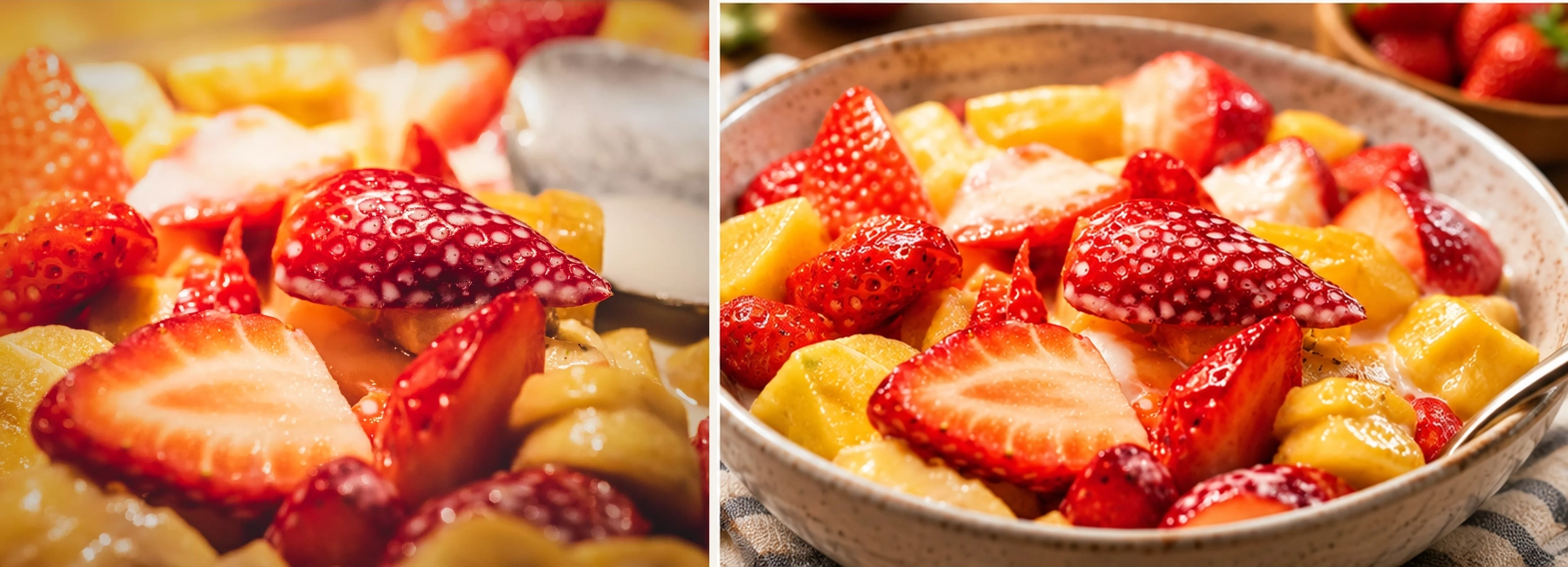
Every restaurant with a delivery presence has the same problem. The top ten items are photographed. Everything below is a name and a price, competing against a competitor's grid of glossy thumbnails.
The cost of that gap is measurable. DoorDash data from a study of over 15,000 local small business merchants found that menus with item photos get up to 44% more monthly sales than menus without. We have covered the same effect from the platform side in how high-quality food photos increase delivery app orders, and the operational version of it in closing image gaps in food delivery.
So the appeal is obvious. Generate the missing forty items, fill the grid, capture the lift. The reason to slow down is equally obvious once said out loud: a food photo is a promise about something the customer will eat in thirty minutes.
What AI is genuinely good at here
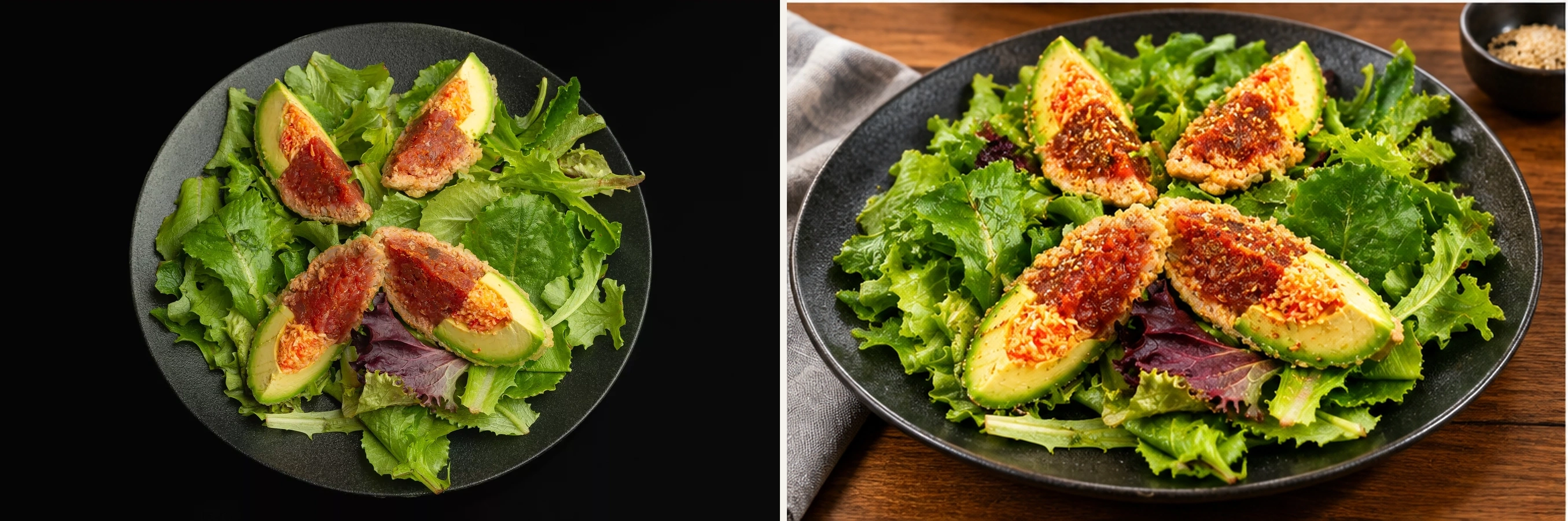
Three jobs, in descending order of reliability.
Backgrounds and surfaces. Take a decent shot of the real dish and drop it onto a cleaner table or a darker slate. The food pixels stay real, and an inconsistent set of phone photos starts to look like one coherent menu.
Relighting and cleanup. Correcting the yellow cast of kitchen fluorescents, lifting shadows, removing a thumbprint on the plate rim. Faster than hand-editing a hundred items.
Variant generation. One shot of a burger becomes four framings for the app tile, the website hero, the social crop and the in-store screen.
All three start from a photograph of the actual food.
Where it breaks
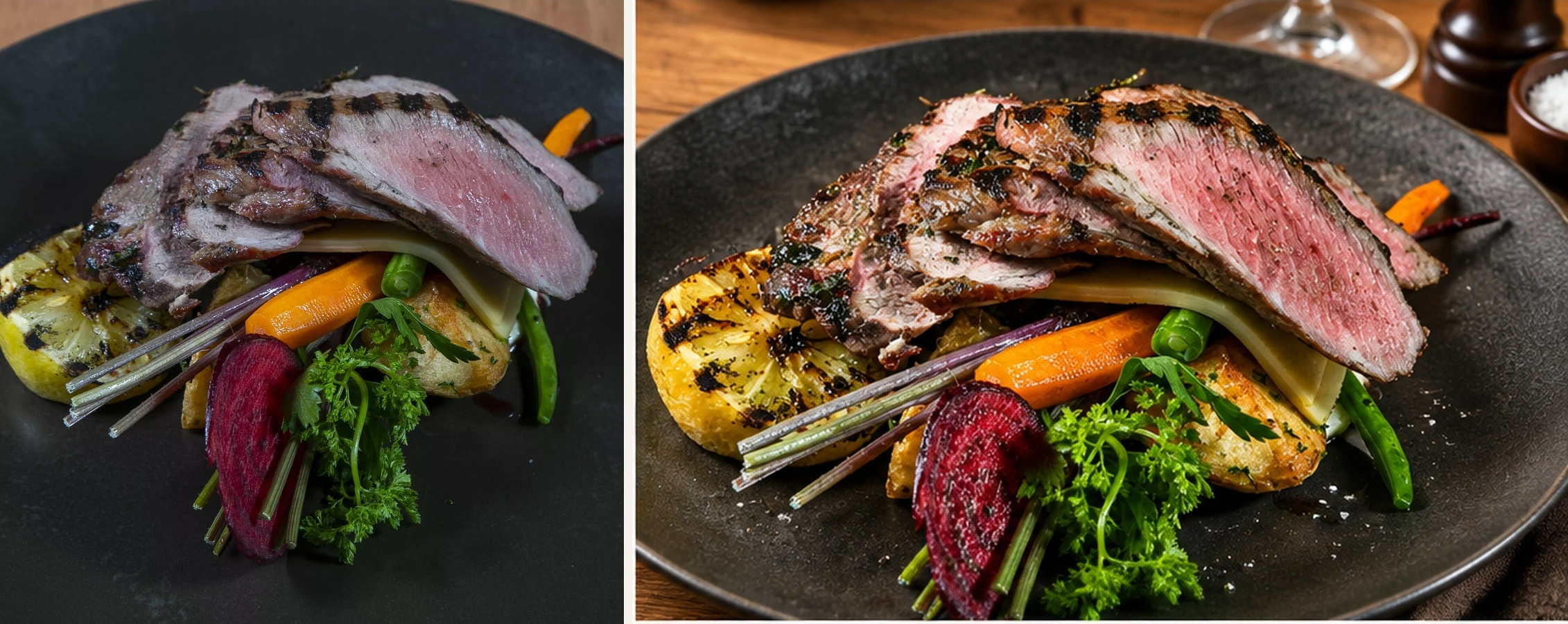
Food is one of the hardest subjects for generative models, because appetite lives in physical detail the model has to invent.
Steam reads as fog, sitting wrong relative to the heat source. Glaze, oil and melted cheese are fluid-dynamics problems, and models approximate them into something subtly plastic. Fine repeating texture smears: sesame seeds, herb flecks, bread crumb, grill char.
Then the two that matter commercially. Portion, where a generated bowl of pasta holds a serving nobody ordered on a plate of invented size. And ingredient accuracy, the most consequential failure of all. Prompt a model for a chicken sandwich and it will confidently add a tomato slice you do not put on it, seeds on a bun you do not use, and a side of fries you charge extra for.
The line you cannot cross
That last failure is a consumer-facing problem, not an aesthetic one, and the platforms already say so. Uber Eats requires that menu images accurately represent a single item from your menu, framed centrally, showing one dish and not two.
The practical rule is simple. AI can change how the food is presented. It cannot change what the food is. Backgrounds, lighting, framing and cleanup are fair game. Ingredients, portion size and plating are not.
Disclosure is tightening around the generated layer too. The EU AI Act's transparency obligation requires providers of AI systems generating synthetic image content to ensure outputs are marked in a machine-readable format and detectable as artificially generated, and C2PA Content Credentials is how that marking is being implemented. Delivery platforms have not enforced this yet. Planning as though they will is the cheaper assumption.
The approach that actually works
Shoot the menu once, properly, and generate from there.
A single photographer visit captures every item in consistent light with accurate color, giving you a real reference frame per dish. From there AI handles the volume work: background variants, seasonal restyles, channel-specific crops. Breadth, without ever publishing a dish that does not exist.
This is how Snappr Magic for Food is built. Photographers cover capture, and the AI layer generates from real menu photography rather than a text prompt, with human quality control inside the turnaround to catch the plastic-looking glaze before a customer does. Our guide to getting more orders on DoorDash and Uber Eats covers where menu imagery fits in the wider picture.
Start with the gap. Count how many menu items have no photo at all, because that number is usually the whole business case. Then decide which need a camera and which only need a background.
Compare Snappr's plans to see how photography and Magic generations work together at your volume.
Frequently asked questions
Is AI food photography good enough for delivery apps?
For presentation work, yes. Background replacement, relighting and cleanup applied to a real photograph of the dish produce app-ready images. Fully generated dishes are a different matter, because current models struggle with steam, glaze, texture and portion accuracy.
Can I use AI to create photos of dishes I have not photographed?
You should not. A menu photo represents what the customer will receive, and generated dishes routinely include ingredients, garnishes and portions that do not match the real item. The gap gets discovered at the door.
Do I need to disclose AI-generated menu photos?
Delivery platforms do not currently require it, but the direction of travel is clear. The EU AI Act requires synthetic image outputs to be machine-readable as AI-generated, and C2PA Content Credentials is the emerging standard for carrying that provenance. Preserving the metadata now costs nothing.
How much do menu photos actually affect orders?
DoorDash's study of more than 15,000 merchants found menus with item photos get up to 44% more monthly sales than menus without. The effect is strongest on items with no image at all, which is why coverage matters more than perfection.
Sources
1. DoorDash, 6 Tips for Taking Amazing Restaurant Menu Photos — study of over 15,000 local small business merchants, menus with item photos get up to 44% more monthly sales
2. Uber Eats, Store submitted menu photo guidelines — menu images must accurately represent a single item from the menu
3. EU AI Act, Article 50 — transparency obligation requiring synthetic image content to be machine-readable as AI-generated
4. C2PA Content Credentials — content provenance and authenticity standard


