
Why the first ten minutes always feel stiff
You've booked the session. You've picked the outfits. Then the photographer lifts the camera, and suddenly neither of you knows what to do with your hands. You stand side by side like two people waiting for a bus, smile on command, and the first twenty frames look like a passport photo with company.
Everyone goes through this. Part of it is simple nerves, and part of it is how your brain reads your own face. In a classic study published in the Journal of Personality and Social Psychology, Mita, Dermer and Knight found that people reliably preferred a mirror-image print of their own face, while their close friends preferred the true image. You're used to the mirror. Your partner is used to the real you. So the photo that makes you wince is often the one your partner loves.
The fix isn't to perfect a stance. It's to give your bodies something to do and your attention somewhere to go, which is exactly what good couple poses do. This guide covers the principles that make any pose work, then walks through classic, candid, walking, sitting, close-up, playful, at-home and outdoor couple poses, with the actual verbal prompts photographers use to get real reactions. There's also a section on height differences, a 60-minute session flow you can steal, and a short note on outfits.
The four rules behind every good couple pose
Photographers don't memorize hundreds of poses. They work from a few principles and improvise from there. Learn these four and you can rescue almost any awkward moment.
Keep at least one point of contact
A hand on a waist, a chin on a shoulder, fingers laced together, knees touching on a bench. Contact is what turns two portraits into one photo of a couple. If there's a gap of daylight between you, close it. Most couples stand further apart than they think, so "closer than feels natural" is usually about right on camera.
Give your hands a job
Loose arms hanging at your sides read as tense. Give each hand somewhere to be: in a back pocket, on your partner's chest, holding a coffee, tucked into a jacket lapel, resting on a knee. Keep fingers soft and slightly curved. A clenched fist or a flat palm pressed on a shoulder looks like a handshake.
Decide where you're looking
There are really only three options: at the camera, at each other, or at the same thing off in the distance. Each tells a different story. Camera eye contact feels like a portrait. Looking at each other feels intimate. Looking off together feels cinematic. Switch between all three in every pose and you'll triple your usable frames without moving your feet.
Angle your bodies, not just your faces
Square-on to the lens, two bodies look wide and flat. Turn slightly toward each other, shift your weight onto your back foot, and bend the front knee a little. Those small angles create shape and make the pose look relaxed even when you aren't.
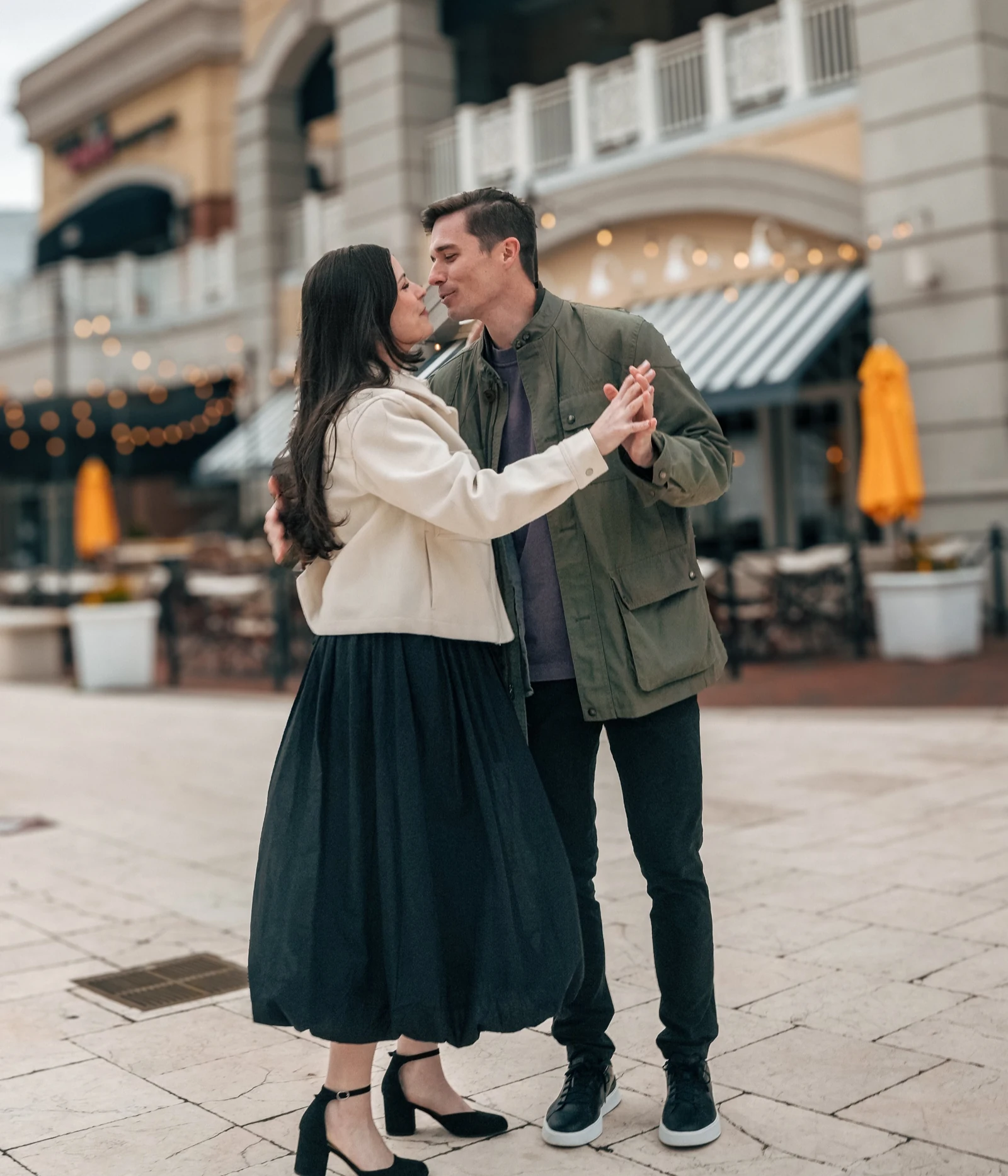
Classic standing couple poses
These are the foundation of every couples session. They're easy to hold, they work anywhere, and they give the photographer a few minutes to dial in light and settings while you warm up.
The side-by-side lean
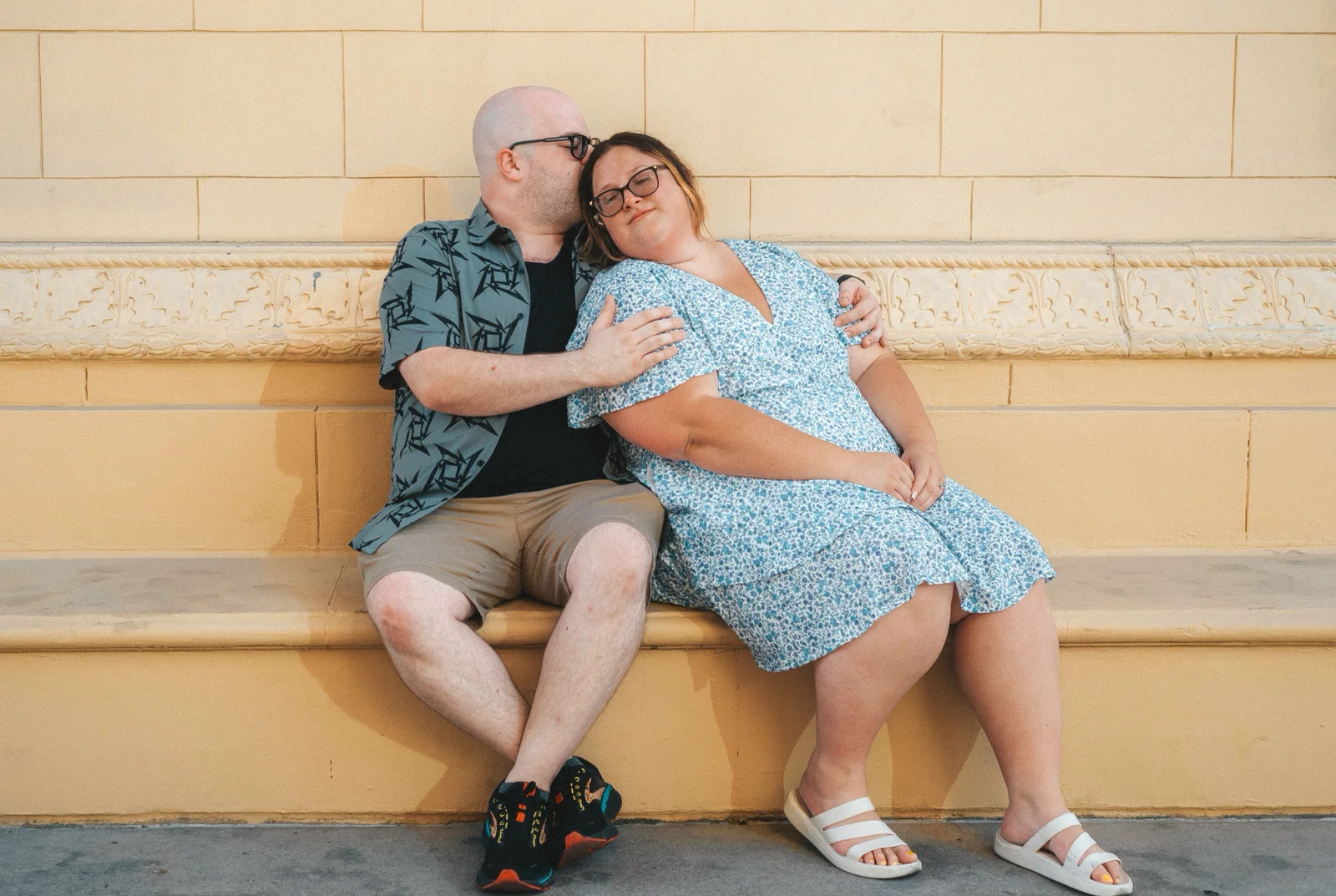
Stand hip to hip, both angled slightly toward each other, holding hands or with arms around each other's waists. The shorter partner leans their head gently toward the taller partner's shoulder. Simple, and it's a strong opener for wider shots that show off the location.
The front-to-front hug, turned to camera
Face each other and step in close, one partner's hand resting on the other's chest. Then both turn your heads toward the camera. You get the warmth of an embrace with both faces fully visible.
The hug from behind
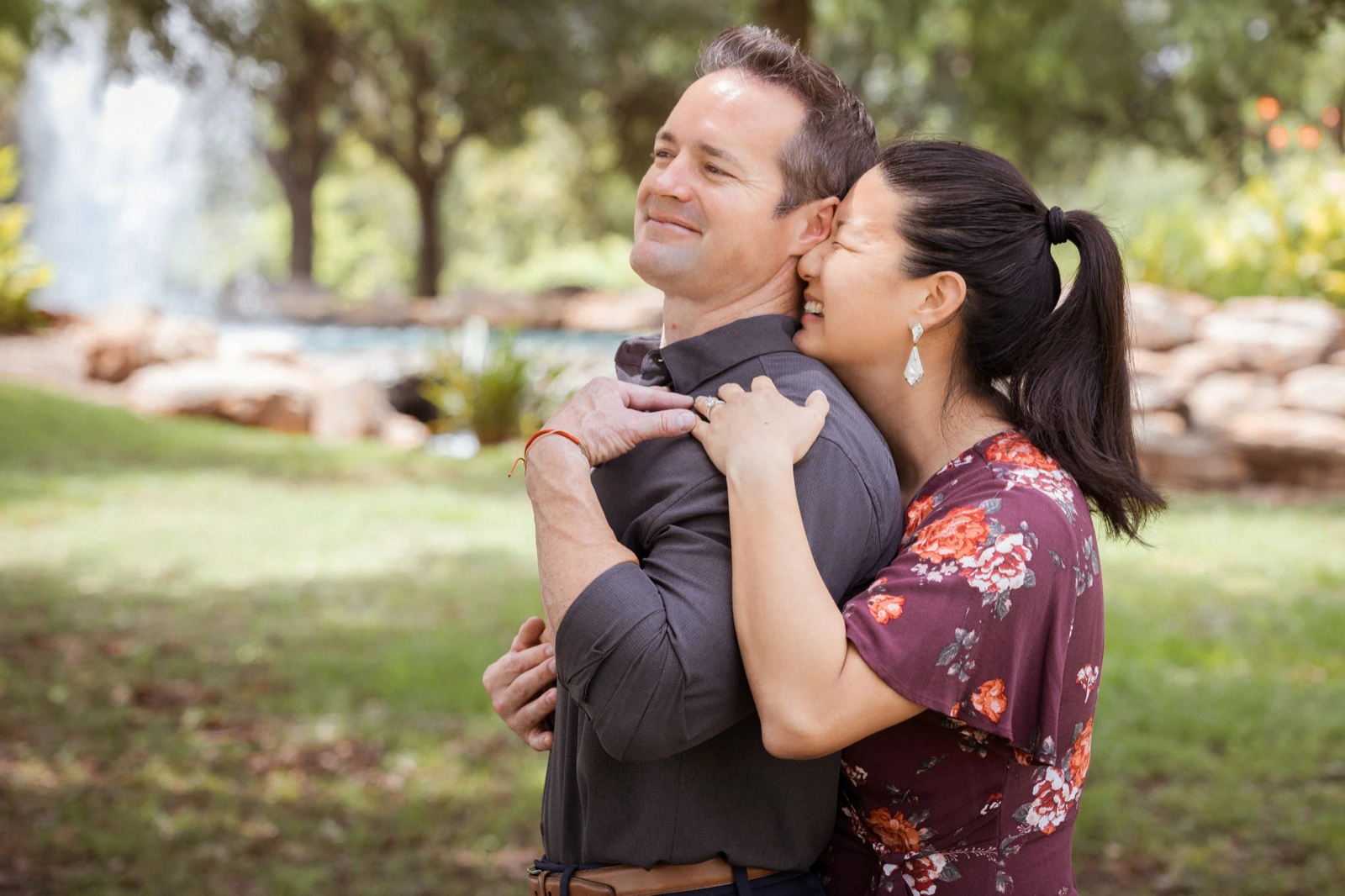
One partner stands behind the other and wraps their arms around the front partner's waist. The back partner rests their chin on the other's shoulder or presses a cheek against theirs. The front partner can hold the wrapped arms or place a hand on the back partner's cheek. Try it looking at the camera, then with eyes closed.
Forehead to forehead
Face each other, hold hands or cup each other's faces, and lean in until your foreheads touch. Eyes closed works beautifully here. It's quiet, emotional and flattering for almost everyone because it hides double chins and awkward smiles.
The staggered stance
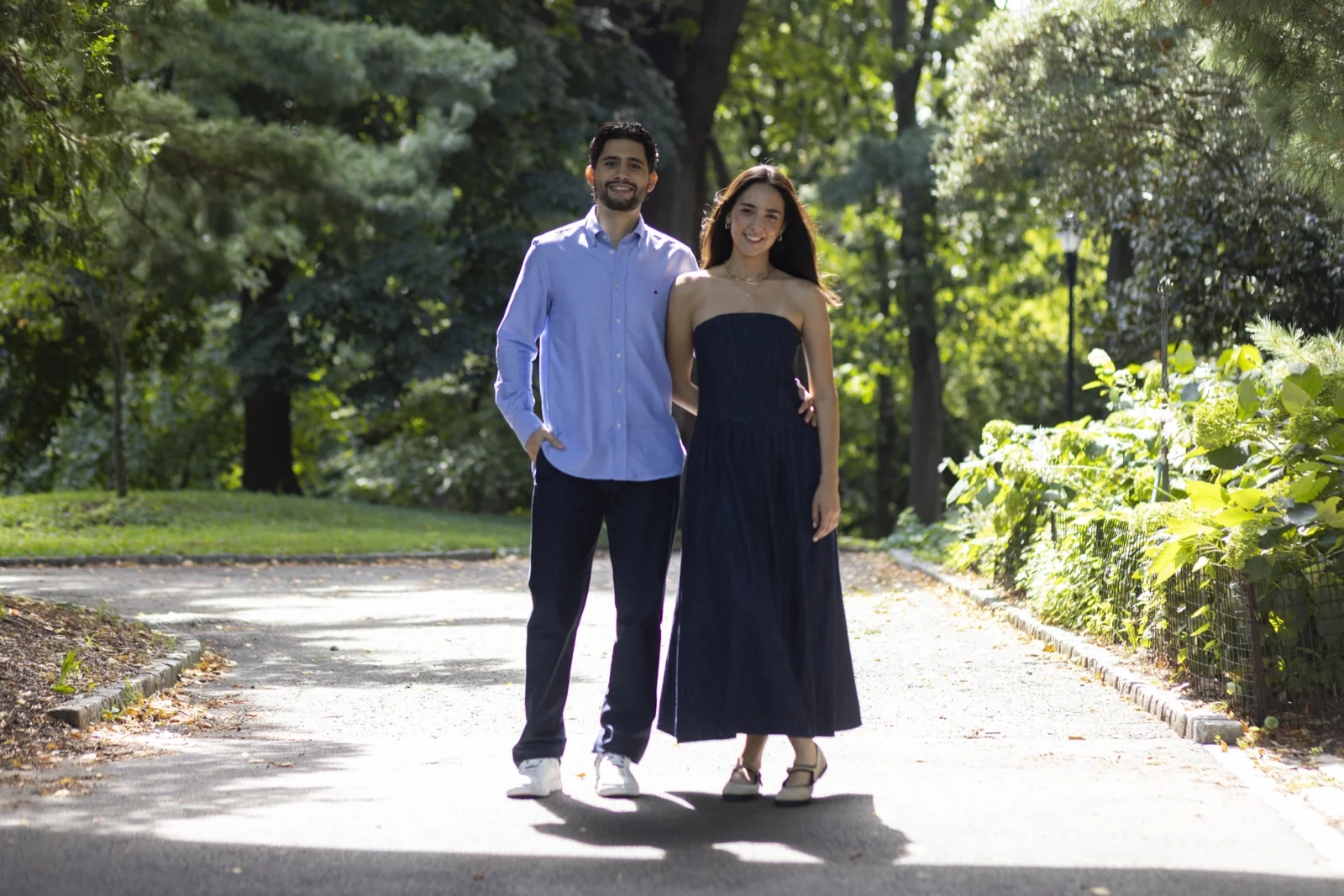
One partner stands slightly in front and to the side of the other, both facing the camera at a gentle angle. The back partner places a hand on the front partner's shoulder or waist. It's the most portrait-like of the classic couple poses, and it's great for anniversary photos you'll frame.

Candid couple poses: the prompts photographers actually use
Here's the thing about "candid" couple photos. Most of them aren't candid at all. They're prompted. A pose tells you where to put your body. A prompt gives you something to do or feel, and your body sorts itself out. The expression that follows is real because the moment is real.
There's good science behind the most famous prompt of all. A University of North Carolina study by Sara Algoe and Laura Kurtz, reported by ScienceDaily, filmed couples as they described how they first met. The researchers found that the more people laughed with their romantic partner, the more supported they felt by them. That's the same conversation photographers start when they say "tell each other how you met."
Try these prompts, and don't overthink the delivery:
• "Tell each other the story of how you met, but get one detail wrong on purpose." Laughter, eye contact and an easy argument, all in one.
• "Whisper the most boring thing you can think of in their ear." The whisperer leans in, the listener cracks up. The anticipation is the shot.
• "Look at each other and try not to laugh. First one to smile loses." Nobody lasts more than five seconds.
• "Give each other a kiss on the cheek, then go back for a second one, slower."
• "Hug like you haven't seen each other in a month." Gets real squeezes and closed eyes.
• "Tell your partner what you noticed first about them." Softer, and often produces the most emotional frames of the day.
• "Rest your forehead on theirs and breathe together for three breaths." A reset for couples who are over-smiling.
• "Show me your worst dance move. Now your partner's worst dance move." Good for high-energy couples near the end of a session.
• "Swap one thing: a jacket, a hat, sunglasses." Gets hands moving and bodies close with zero instruction.
If a prompt doesn't land, move on without making it a thing. The photographer's job is to keep the pace up so no one has time to feel self-conscious.
Walking and movement poses
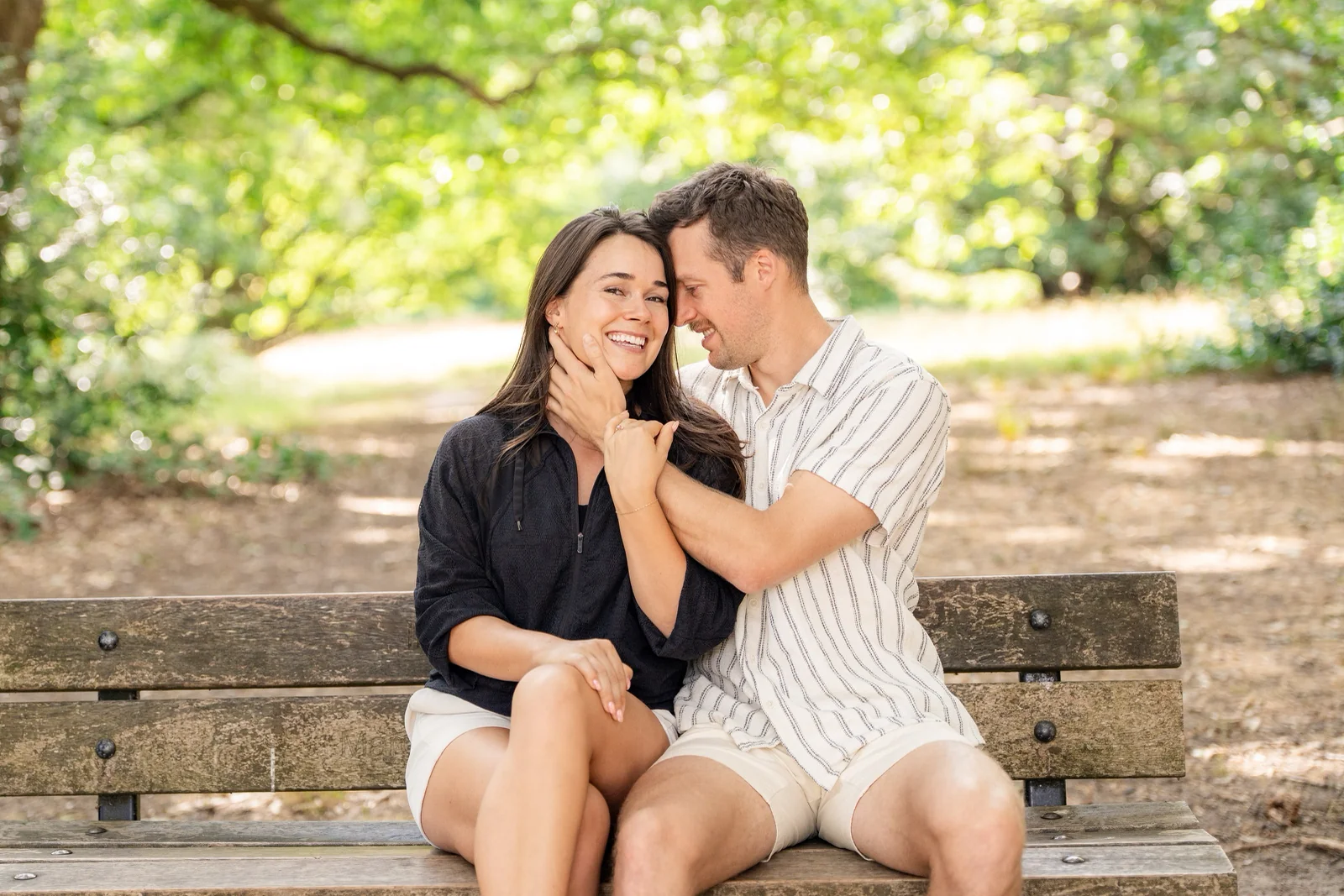
Movement is the fastest way to loosen up a stiff couple. When you're walking, you stop thinking about your face, and the photographer can shoot a burst and pick the best step.
Walk toward the camera
Start about ten paces back, hold hands and walk slowly toward the photographer. Look at each other, then at the ground, then back at the camera. Bump hips once halfway. Slow is the key word: walk at half your normal speed.
Walk away and look back
Walk away from the camera hand in hand, then on a cue, one partner glances back over their shoulder. It's cinematic and forgiving for camera-shy couples because faces only appear for a second.
The lead
One partner walks a step ahead, reaching back to lead the other by the hand. Photographed from behind the leading partner, it's the classic "follow me" frame that travel photographers love.
Twirl and catch
Hold hands, one partner spins the other under their arm, then pulls them in close. Shoot the whole sequence. The frame after the catch, when both of you are laughing, is usually better than the twirl itself.
The dip
A slow-dance dip, one partner supporting the other's back. Practice it once off camera so nobody gets dropped.
Holding hands is doing more than filling your hands, too. In a University of Virginia study published in Psychological Science and described by the Association for Psychological Science, James Coan had 16 married women undergo an fMRI scan while receiving a small electric shock. They reported less unpleasantness while holding their husband's hand than a stranger's hand or no hand at all, and the happiest couples felt the most relief. That kind of calm is exactly what you want on camera.
Sitting and lying couple poses
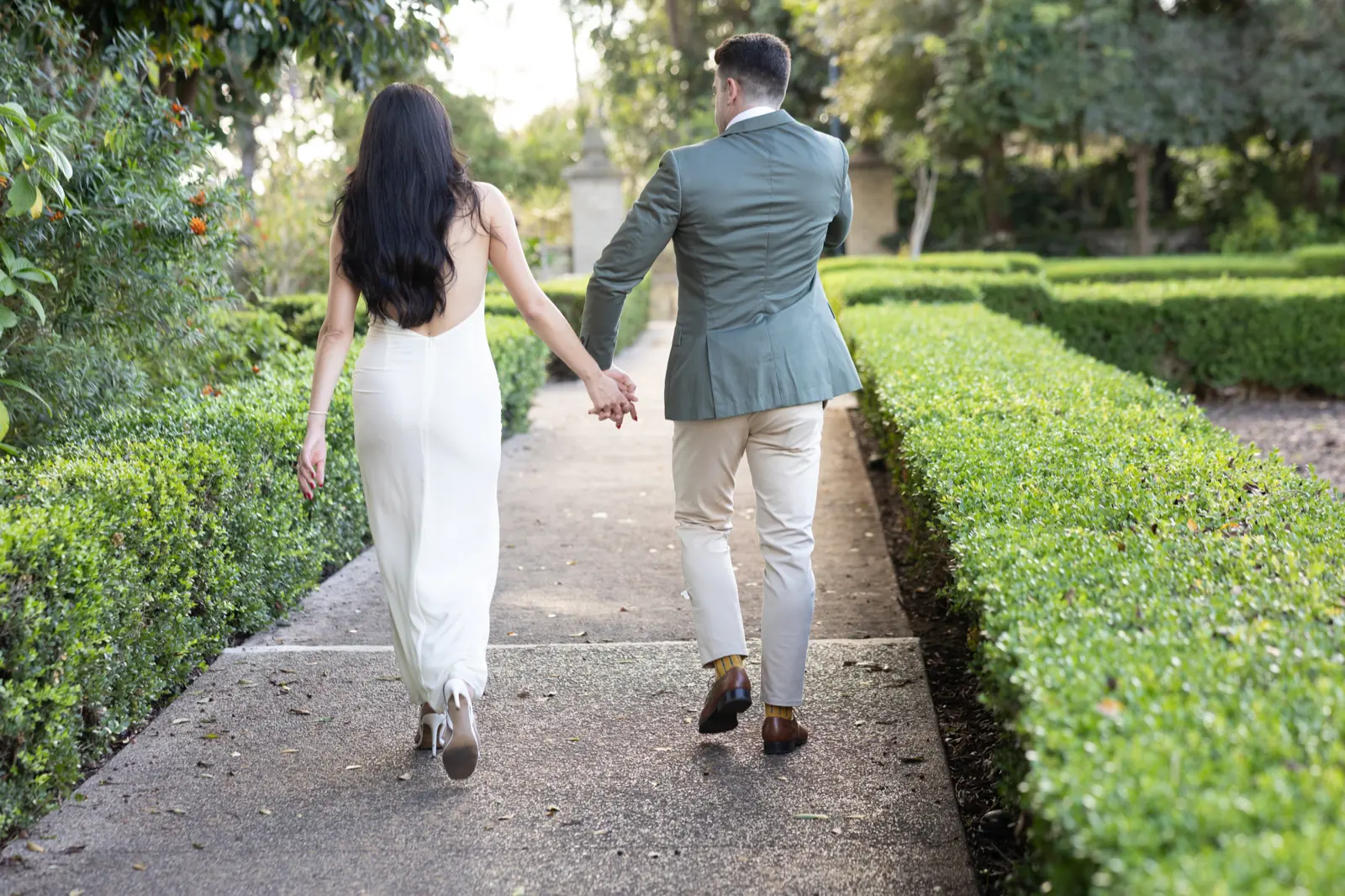
Sitting poses feel more relaxed, and they solve half the height problems couples worry about. Look for steps, low walls, benches, a blanket on grass or the edge of a sofa.
Nestled
One partner sits behind the other, legs on either side, arms wrapped around their waist. The front partner leans back into their chest. Works on steps, on a blanket or on a bed.
Legs intertwined, facing each other
Sit facing each other, legs looped over or between each other's, foreheads close or laughing at something just said. Photographed from the side, it shows off shape and closeness.
Side by side, looking out
Sit next to each other on a bench or ledge, shoulders touching, both looking at the view. One partner rests their head on the other's shoulder. Shot from behind or three-quarters, it's quiet and cinematic.
Head on lap
One partner sits on a blanket, the other lies back with their head in their lap and looks up. The sitting partner looks down and plays with their hair. Easy to hold for a long time.
Lying heads together
Both lie on your backs on a blanket or in grass, heads next to each other, pointing opposite directions. The photographer shoots from directly above. Hold hands between you and look at each other, then at the camera.
Close-up and romantic couple poses
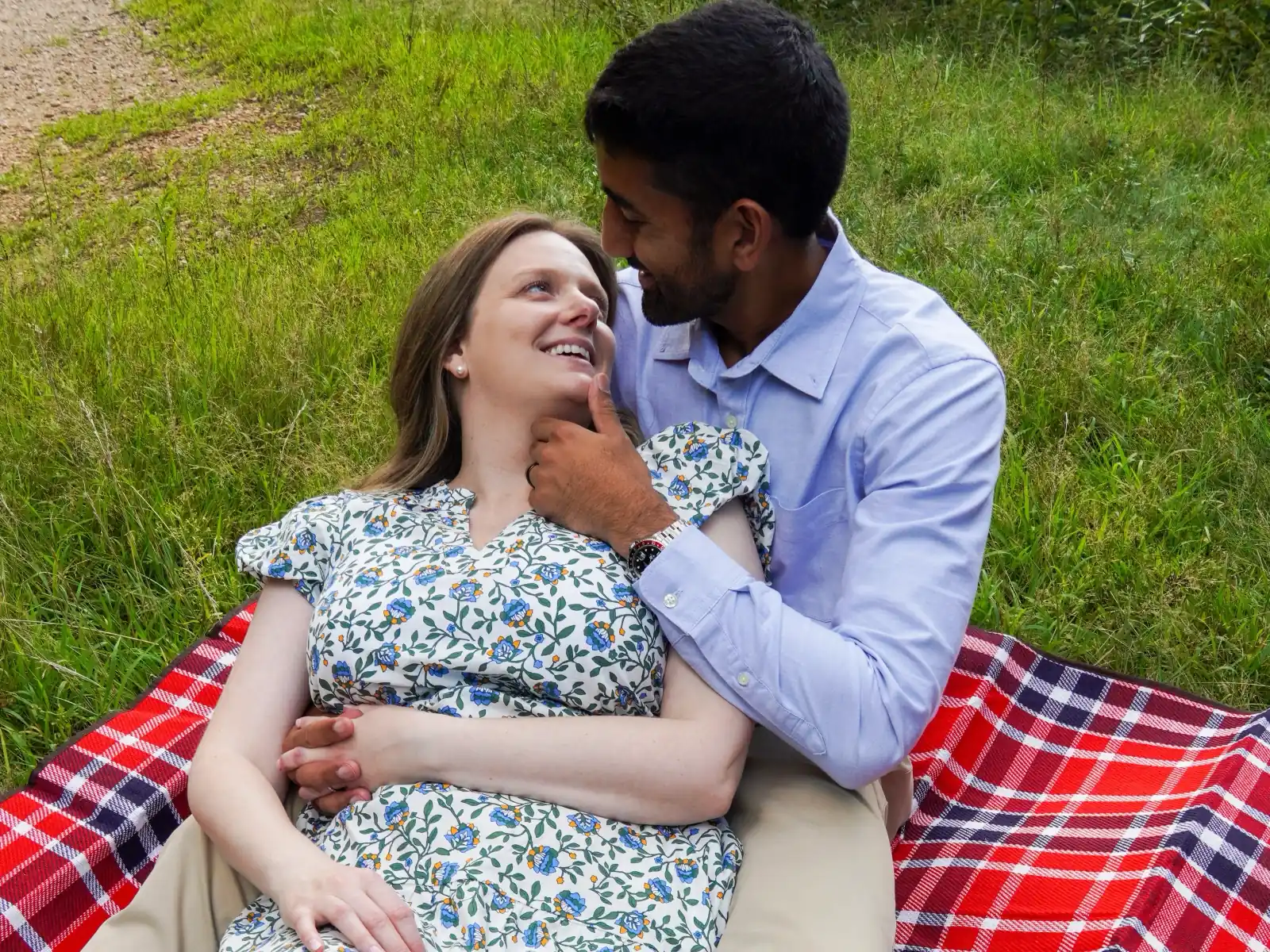
Close-ups are where emotion lives. They're also the frames that end up on phone lock screens and anniversary cards, so ask for a few in every session.
• The almost-kiss: lean in as if to kiss, then stop an inch apart and hold. The anticipation photographs better than the kiss itself.
• The forehead kiss: one partner kisses the other's forehead while the other closes their eyes and smiles.
• Nose to nose: foreheads touching, eyes open, both trying not to laugh.
• Face in hands: one partner gently holds the other's face, thumbs at the jaw, looking at each other.
• Hands only: a tight crop of laced fingers, a hand on a knee or a thumb stroking a wrist. Photographers call these detail shots, and they add a layer of story no full-length pose can.
• Eyes closed, cheek to cheek: soft, still and flattering for camera-shy couples.
For the kiss itself, keep it soft. A light kiss with relaxed faces looks romantic; a big kiss squashes noses and faces.
Poses for couples with a height difference
Plenty of couples have one. The CDC's FastStats page puts the average height of US adult men at 68.9 inches and women at 63.5 inches, a gap of about five and a half inches before shoes. And a PLOS ONE study by Stulp and colleagues, using UK Millennium Cohort Study data, found the man was taller than the woman in 92.5% of couples. Same-sex couples and couples where the woman is taller have height gaps too, of course. The fixes below work for any combination.
A height difference isn't a problem to hide. In side-by-side and hug-from-behind poses, it can make the photo look more dynamic. The only real challenge is getting both faces into the same close-up without one partner bending like a question mark. Here's how photographers handle it:
• Widen the taller partner's stance. Feet apart drops them an inch or two with no visible slouch.
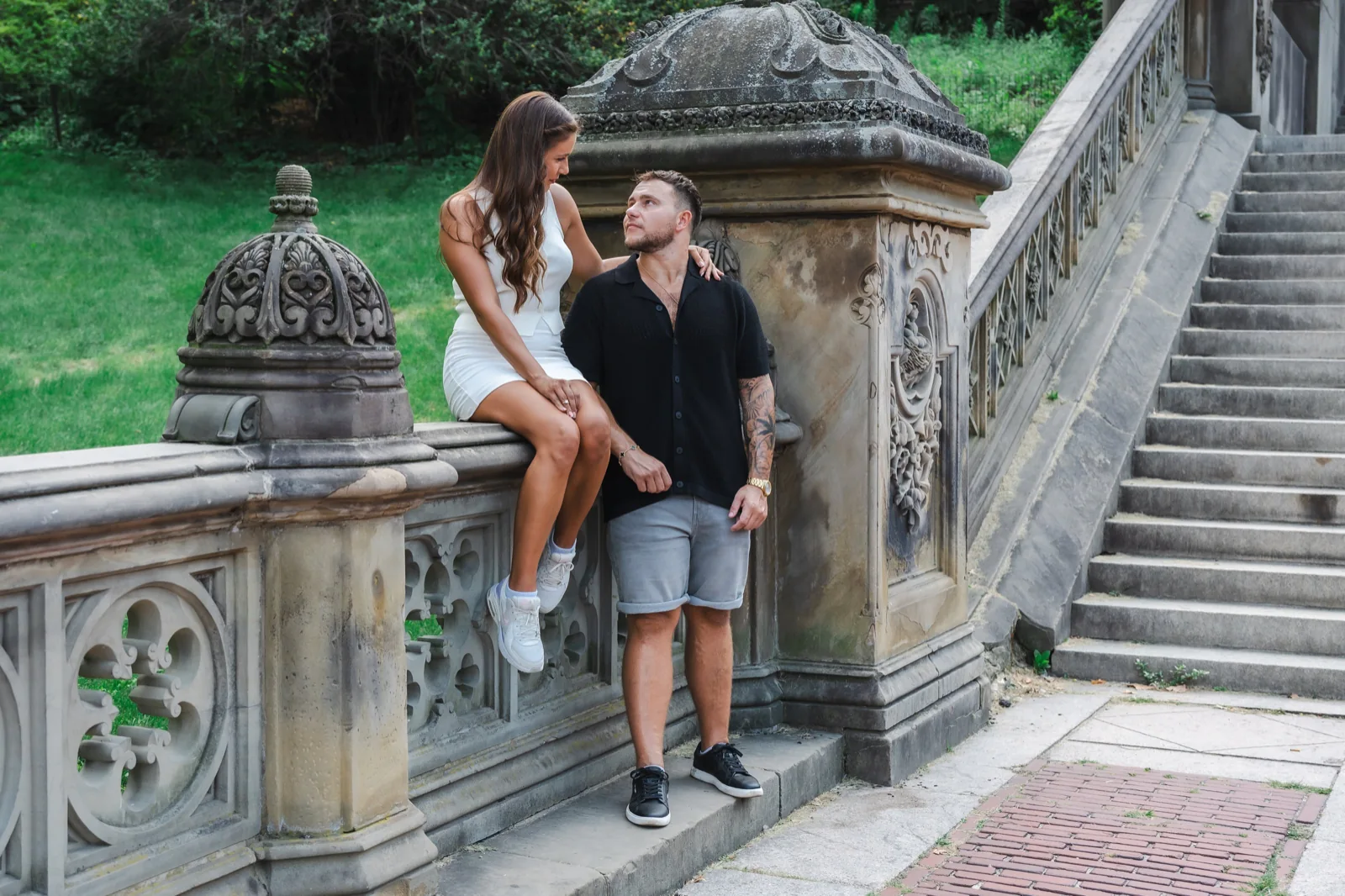
• Use terrain. Put the shorter partner on a step, curb, rock or tree root. The camera never has to see it.
• Sit down. On a bench, a ledge or a blanket, a height gap shrinks to almost nothing, since much of the difference is in the legs.
• Lean on something. The taller partner leans back against a wall or railing and the shorter partner leans into them.
• Chin on head. In a hug from behind, the taller partner rests their chin on the shorter partner's head. Cute, not awkward.
• Tip the heads, not the spines. For close-ups, the taller partner bends forward from the hips and tilts their head down while the shorter partner lifts their chin.
• Drop the camera a little. A slightly lower angle makes the taller partner's downward glance look protective rather than looming.
If the height gap goes the other way from what you expect, lean into it. Photographers don't care who's taller, and neither will anyone looking at the album.
Playful couple poses
Not every couple wants soft and romantic. If you're the kind of pair who bickers about board games, show it.
• Piggyback: one partner jumps onto the other's back, both laughing toward the camera. Do it a few times, as the second or third attempt is usually the funniest.
• Back to back: stand with your backs pressed together, arms folded, looking over your shoulders at each other like you're in an action movie poster.
• The lift: one partner lifts the other off the ground in a hug and spins. Shoot the moment feet leave the ground.
• Feed each other: an ice cream cone, a slice of pizza, a strawberry. It gets hands busy and faces real.
• The cheers: clink two coffees or two drinks at a café table and look at each other, not the glasses.
• Umbrella or jacket share: huddle under one umbrella or one jacket in drizzle. Rain is a gift for couples photos, not a cancellation.
At-home and lifestyle couple poses
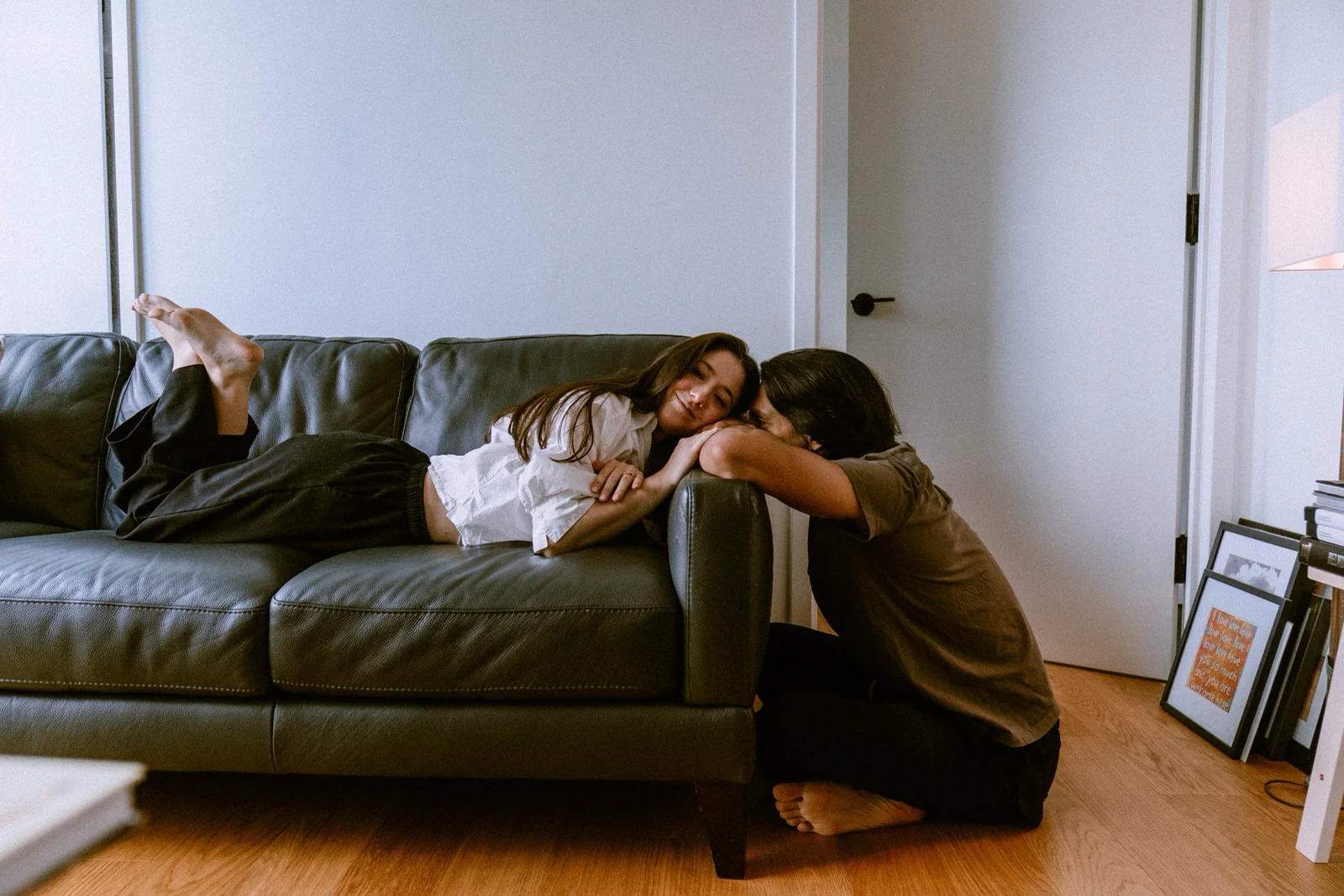
Plenty of couples skip the scenic overlook entirely and book a session at home. It's where your relationship actually happens, and the photos show it. Lifestyle shoots need fewer poses and more activities.
• Cooking together: one partner stirs, the other steals a taste off the spoon. Kitchens have great window light.
• Coffee on the couch: legs tangled under a blanket, two mugs, one partner reading aloud.
• Slow dance in the living room: put on a song you both know and dance barefoot. This is the easiest at-home couple pose for shy couples, because music takes over.
• Reading in bed: both propped on pillows, one partner's head on the other's shoulder, morning light from the window.
• Making the bed: a sheet thrown between you gets laughs, motion and soft fabric in frame.
• Doorway moments: leaning in the front door frame, coffee in hand, as if one of you just got home.
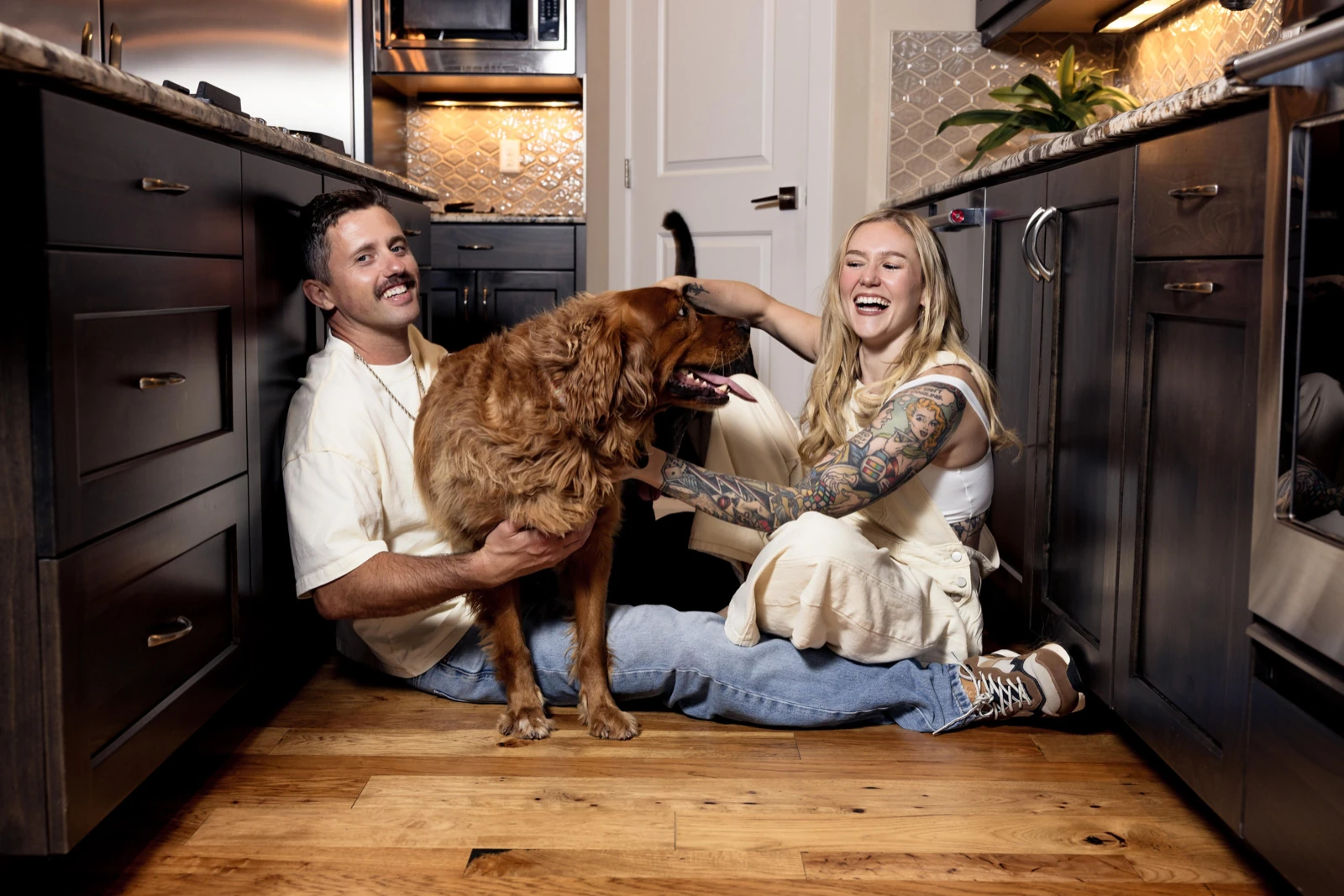
• With the dog: pets do half the work. Photograph both of you watching the dog, not the camera.
For the best light at home, open every curtain, turn off overhead bulbs and work near the biggest window. Mixed light sources give skin a muddy color.
Outdoor couple photo ideas by location
The setting changes which poses shine. A few couple photo ideas matched to common locations:
• Parks and fields: walking, lying in the grass, twirls and wide shots with lots of space. Hugging in the middle of an open field with the horizon behind you is a classic for a reason.
• City streets: walking across a crosswalk, leaning against a wall, sharing a coffee at a café table, kissing under a streetlight at dusk.
• Beaches: walking along the waterline, piggybacks in the shallows, sitting wrapped in one towel. Our guide to beach photoshoot poses has more ideas built for sand and surf.
• Forests and trails: leaning against a big tree, walking a path in dappled light, sitting on a fallen log.
• Rooftops and views: side-by-side looking out, silhouettes against the sky, the hug from behind facing the skyline.
Timing matters as much as location. Timeanddate.com explains that the warm light of golden hour most likely occurs when the Sun is between 6 degrees below and 6 degrees above the horizon, and that at around 40 degrees of latitude, like New York, it lasts around an hour in March. Book your outdoor session to end right around sunset, and read our breakdown of the best and worst options for outdoor photo light before you pick a time. Midday sun is the enemy of couple poses: hard shadows under the eyes and a lot of squinting.

A 60-minute couples session flow you can steal
Many couples book a one-hour session. A structure keeps it from feeling like a random list of instructions, and it moves you from easy to expressive at the pace most people warm up. Here's a flow photographers use in some form:
1. Minutes 0 to 10, warm-up. Side-by-side lean, staggered stance, hug from behind. Low effort, lots of chatting. The photographer sets exposure and you stop noticing the camera.
2. Minutes 10 to 25, walking and movement. Walk toward the camera, walk away and look back, the lead. Movement burns off nerves.
3. Minutes 25 to 40, prompts and play. Whisper prompts, "how we met," the no-laughing contest, piggybacks. This is where the most natural frames happen.
4. Minutes 40 to 50, sitting and close-ups. Find a bench or blanket. Nestled, head on lap, forehead to forehead, hands-only details. By now you're relaxed enough for the quiet shots.
5. Minutes 50 to 60, the finale. Save the best light and the biggest moment for last: the dip, the lift, a kiss at sunset, a wide shot of the whole scene.
Build a simple shot list together before the day. Pick three or four poses from this guide you both love, screenshot some reference ideas, and share them with your photographer. You'll spend less time deciding and more time being yourselves.
Couple poses for camera-shy partners
Often one partner loves photos and the other would rather be anywhere else. Here's how to make the session work for both of you.
• Give the shy partner a task. Holding the umbrella, carrying the coffee, leading the walk. Hands with a purpose relax the whole body.
• Favor poses where faces are partly turned: walking away, looking out at the view, hugs from behind with eyes closed, or kisses on the cheek.
• Let the confident partner do the performing. The shy partner just reacts, and a genuine reaction is the best expression anyone makes.
• Ask the photographer to use a longer lens from further back, so it feels like a walk with a friend nearby rather than a camera in your face.
• Remember the mirror effect. The version of your face you see in photos isn't the one you see in the mirror every day. Your partner has seen the real one for years and likes it.
What to wear for couple photos
Coordinate, don't match. Pick a palette of three or four colors and let each of you wear a different piece from it, with one partner in a subtle pattern at most. Mix textures like knit, denim, linen and leather, avoid big logos, and bring a layer you can add or remove to change the look halfway through. Wear shoes you can walk in, because half the best couple poses involve moving. Our guide on how to pick outfits for photoshoots goes deeper on colors, fit and what photographs well.
How couple poses change for milestone sessions
The basics carry over to every kind of couples session, but each type has its own signature frames.
Engagement sessions put the ring front and center: hands in the foreground, the proposal location, a "save the date" style portrait. For ring-focused ideas, see our dedicated guide to engagement photo poses.
Anniversary and just-because sessions are about the relationship as it is right now. Recreate a photo from early in your relationship, go back to the place you met, bring the dog, or shoot at home. Personal beats polished.
Maternity sessions shift the focus to the bump, with hands framing it and the partner behind or kneeling. Our roundup of maternity photo poses covers the positions that are comfortable late in pregnancy.
Book a couples photographer who knows how to pose you
You can take great couple photos on a phone timer. But a photographer who directs you, reads the light and keeps things moving gives you something a timer can't: the chance to forget about the camera entirely.
That's what a Snappr couples session is built for. Snappr's booking page says you can book in less than two minutes, with as little as two hours' notice, at fixed prices from less than $100. A vetted local photographer shows up with professional gear, runs the session, and Snappr delivers your edited photos within 48 hours. Bring this guide, pick your favorite couple poses, and let the photographer handle the rest.
Book a couples photoshoot with Snappr and get photos that look like the two of you on a good day.
Frequently asked questions
What are the best couple poses for beginners?
Start with the side-by-side lean, the hug from behind, forehead to forehead and walking hand in hand toward the camera. They're easy to hold, flatter most body types and give you something to do with your hands. Add prompts like "whisper something in their ear" once you've warmed up.
How do you make couple poses look natural?
Use prompts instead of rigid poses. Give each other something to do, like telling the story of how you met or trying not to laugh, and let the photographer capture the reaction. Keep at least one point of contact, stay closer than feels normal and keep moving between frames.
How do you pose a couple with a big height difference?
Have the taller partner widen their stance, put the shorter partner on a step or curb, or sit down so the gap shrinks. For close-ups, the taller partner bends from the hips and tilts their head down while the shorter partner lifts their chin. In hug-from-behind poses, the taller partner can rest their chin on the other's head.
What should couples do with their hands in photos?
Give every hand a job: in a back pocket, on a waist, on a partner's chest or cheek, laced with the other's fingers, or holding a prop like a coffee. Keep fingers soft and slightly curved. Hands hanging loose at your sides are the most common reason couple photos look stiff.
What are good couple photo ideas at home?
Cook together, slow dance in the living room, drink coffee on the couch under a blanket, read in bed or play with your pet. Work near the biggest window, open every curtain and switch off overhead lights so your skin tones stay clean.
How long does a couples photoshoot take?
Many couples book a one-hour session, which is enough time for a warm-up, walking shots, prompts, sitting poses and close-ups without anyone getting tired. Shorter sessions work too if you plan three or four couple poses in advance and shoot in one location.
Sources
1. Mita, Dermer and Knight (1977), "Reversed facial images and the mere-exposure hypothesis," Journal of Personality and Social Psychology, via APA PsycNet: people prefer their mirror image, friends prefer the true image
2. ScienceDaily / University of North Carolina at Chapel Hill, "The little things: Gratitude and shared laughter strengthen romantic partnerships" (2016): Kurtz and Algoe filmed couples describing how they first met; more shared laughter linked to feeling supported
3. Association for Psychological Science, "I Need to Hold Your Hand: The Social Regulation of Emotion": Coan's University of Virginia hand-holding fMRI study of 16 married women
4. CDC National Center for Health Statistics, FastStats: Body Measurements: average US adult height, men 68.9 inches, women 63.5 inches
5. Stulp et al. (2013), "Are Human Mating Preferences with Respect to Height Reflected in Actual Pairings?", PLOS ONE: man taller than woman in 92.5% of couples in the UK Millennium Cohort Study
6. Timeanddate.com, "What Is the Golden Hour?": golden hour sun angle and duration by latitude


